'Anent the Scots Leid an its Makars'
by James Graham
In a website I visit from time to time, you can click on such things as Rake, Steid Cairt, and Airtins tae ither Wabsteids. This is the Scots language website Scots Online. 'Rake' could be trendily translated as 'Google' - but literally it's 'search'. The 'Steid Cairt' is the site map, and 'Airtins tae ither Wabsteids' means links to other websites.¹ Such coinage of technical terms in Scots is, to say the least, rather artificial, since no-one says in conversation, ‘D’ye ken the Linnet’s Wings wabsteid?’
The spoken language still exists, mainly in rural areas and small towns, but in a diluted form. It’s not yet a dead language, but it’s not ‘alive’ enough to assimilate coinages and borrowings, and bits and pieces of its vocabulary are easily lost in favour of their English equivalents.
Some would say it’s as good as dead. The trouble is, it won’t lie down. Throughout the twentieth century, right up to the present, there have been writers—especially poets—who have used it in their work, often with astonishing vibrancy. As the spoken language becomes more and more sparse, literary Scots seems to have gone from strength to strength. It is this surprising fact that prompts me to write this essay.
I want to share a few samples of the Scots poetry I love and admire —poetry which is part of the poetic heritage of the British Isles, but may for obvious reasons be a little challenging to those not familiar with the language. Since Scots has been with me since childhood, and I can read it as easily as I read English, it's difficult to know how comprehensible it is to English hearers or readers, or to Americans or Australians. If my notes and translations are too obvious, too spelled out, I apologise. Contrariwise, I hope they're spelled out enough!
First, a mini-treatise on the language. Then the poems.
The Leid
Here's a sample of Scots first of all, a familiar text to give us a flavour of the language. The English version that follows is more or less a literal translation.
1 The Lord is my herd, nae want sal fa' me:
2 He louts me till ligg amang green howes; he airts me atowre by the lown watirs:
3 He waukens my saul; he weises me roun, for his ain name's sake, intil right roddins.
4 Na! tho' I gang thro' the deadmirk-dail; e'en thar, sal I dread nae skaithin: for yersel are nar-by me; yer stok an' yer stay haud me baith fu' cheerie.
5 My buird ye hae hansell'd in face o' my faes; ye hae drookit my head wi' oyle; my bicker is fu' an' skailin.
6 E'en sae, sal gude-guidin an' gude-gree gang wi' me, ilk day o' my livin; an' evir mair syne, i' the Lord's ain howff, at lang last, sal I mak bydan.
1.The Lord is my shepherd, no want shall befall me
2.He makes me to lie among green pastures; he leads me beside the still waters.
3.He awakens my soul; he guides me [round] for his own name's sake, into right paths.
4. No! though I walk through the death-dark valley; even there, I shall fear no hurt: for you are near me; both your rod and your staff keep me very cheerful.
5.My table you have bestowed in the presence of my enemies; you have anointed my head with oil; my cup is full and spilling over.
6.Surely shall goodness [good guidance] and mercy [good reward] go with me, every day of my life; and for ever, in the Lord's own house, at long last, shall I make my home.
This Scots version of the 23rd Psalm, or one very like it, would be commonly heard in churches at any time up to the 19th century. Scots was also the language of the laws and of the law courts—that is, used by judges and lawyers as well as defendants. It was a 'complete' language in the sense that it was used throughout society.
It began as a variant of Northern Anglo-Saxon—just as Anglo-Saxon in turn had begun as a variant or dialect of the Northern Germanic language spoken by the Saxons before they migrated across the North Sea.
Virtually all literature not written in Gaelic was written in Scots. Even in its heyday there was always some vocabulary shared with English, but in the 17th century mutual comprehension between Scots and English speakers would have been difficult.2 Since then its status has declined.
Even so, it's still widely taught in schools, not merely as a salvage operation but much more importantly because of the quality of the literature that has been written in Scots from the late Middle Ages to the present. The literary tradition is so strong that no teacher working in Scotland can reasonably justify its omission from the curriculum. Every teacher of English literature has to be a teacher of English and Scots literature.
During my thirty-odd years of teaching English and Scots, I found that most Scottish schoolchildren enjoyed poems and stories in Scots. For younger children there's a whole genre of 'bairnsangs', and for senior pupils there's the work of Burns, the Scots short stories of Walter Scott and Robert Louis Stevenson, and the astonishingly rich Scots poetry of Hugh MacDiarmid and others in the twentieth century. In the classroom, the language itself presents little difficulty. There are always some obsolete words, or some regional words, that the children don't recognise, but there's always a glossary to help them with these. And even if they don't speak the whole language of the text in front of them, in some indefinable way it always seems a 'natural' language for most of them, like a second language heard and spoken from infancy. In any case their engagement with the stories and poems tends to overcome any linguistic problems that remain.
The Makars - Burns
Arguably the greatest writer in Scots is Robert Burns—though he has his rivals. Despite calumnies that are still sometimes uttered about his supposed drunkenness and promiscuity, Burns is profoundly admired and respected among Scots. The project he undertook in the last years of his life, which he did without payment as a labour of love, was to enrich and secure for all time the heritage of Scottish song.
In a time of failing health, and increasing poverty after he had to give up his farm at Ellisland near Dumfries, he contributed more than 300 songs to two major collections published in Edinburgh—songs that are still sung by professional and amateur singers, in concert performances, at weddings and funerals, and while gardening or doing the housework.
Burns had a genius for a very special art that few poets or composers have been able to master—the rare skill, not of setting a poem to music as Schubert did so superbly, but of putting words to an existing tune.
In just this way, to an old folk tune that could be played on the fiddle he put these words:
Summer's a pleasant time,
Flowers of ev'ry colour;
The water rins o'er the heugh,
And I long for my true lover!
Aye waukin, O,
Waukin still and weary:
Sleep I can get nane,
For thinking on my dearie.
When I sleep I dream,
When I wauk I'm eerie;
Sleep I can get nane,
For thinking on my dearie.
Lanely night comes on,
All the lave are sleepin:
I think on my bonny lad
And I bleer my een wi greetin.
Heugh (pron. hyuch) - rock, crag; waukin - waking; the lave - the rest, the others; bleer - inflame
Burns produced a rich treasury of songs like this - and an equally rich repository of comic and satirical songs.
He was also a great comic writer and satirist. There's no better example of his satire than Address to the Deil, of which a few snippets follow. Remember the poem was written in an age when the Devil was no mere fantasy figure; when a minister could put real anxiety into the hearts of his congregation by telling them Satan was writing in his book the names of all the drinkers, fornicators and intermittent church attenders in the parish. I don't think at that time belief in the actual existence—indeed, immanent presence—of the Devil was anything like universal, but it was widespread.
Burns ironically places under the poem's title a quotation from Milton's Paradise Lost
O Prince, O chief of many throned powers,
That led th'embattled Seraphim to war...
then immediately launches into:
O thou, whatever title suit thee!
Auld Hornie, Satan, Nick, or Clootie,
Wha in yon cavern grim an' sooty
Closed under hatches,
Spairges about the brunstane cootie
To scaud poor wretches!
Clootie- cloven; spairges - splashes (implying, in a clumsy, messy way); brunstane cootie - brimstone bowl; scaud - scald. (A cootie can be several kinds of container, including a chamber-pot. I like to think that was among the meanings Burns intended.)
Satan's 'real name' is included, but the rest are impudent nicknames; and the description of Hell is
a purely comic scene far removed from Dante or Milton. The derisive tone of this opening gambit is pretty clear.
So far the poem's speaker, for all he talks so insolently, nevertheless seems to assume the Devil exists. At the same time the poem is infused with such irony that anyone who so blatantly thumbs his nose at the Devil must be more than half certain of his chimeric status. As the poem develops the 'address' to this shadowy figure becomes much more nuanced. We hear how the Devil appears in many forms, including the Miltonic—as a roaring lion, or riding the 'strong-winged tempest'. This is the fearful creator of all evil, God's adversary, who represents the terror of eternal punishment. Burns gives the Devil a good build-up, especially his capacity to assume cunning disguises; but then comes the deliberate anti-climax:
e dreary, windy, winter night,
The stars shot down wi sklentan light,
Wi you, mysel, I gat a fright
Ayont the loch:
Ye, like a rash-buss, stood in sight,
Wi wavin sugh.
The cudgel in my neive did shake,
Each bristl'd hair stood like a stake,
When wi an eldritch, stoor quaick, quaick,
Amang the springs,
Awa ye squatter'd like a drake,
On whistling wings.
sklentan - shimmering; ayont- on the other side of; sugh- sigh, or the sound of a gust of wind; neive- fist.
I remember one winter night, the poet tells Satan affably, you did give me a bit of a fright, when you assumed the form of a wild drake rustling a clump of reeds (rash-buss) down by the loch and then taking off with 'an eldritch, stoor quaick, quaick' (an unearthly, harsh quack-quack). So with God's adversary now in the form of a quacking duck, we begin to see his power diminishing. In fact ... dare we think the unthinkable? Can it be that it's not Satan in the form of a wild duck in the reeds ... that after all it's only a duck?
Later in the poem Burns gives a lyrical description of Adam and Eve in Eden, and takes the Devil to task for interfering:
Then you, ye auld, snick-drawing dog!
Ye cam to Paradise incog,
An' played on man a cursed brogue,
(Black be your fa'!)
An' gied the infant warld a shog,
Maist ruined a'.
You old cat-burglar, he tells Satan no less amiably than before ('snick-drawing' means stealthily pulling a door-latch or bolt), you entered Paradise incognito, played a filthy trick (brogue) on humanity, gave the infant world a bit of a shake (shog), and ... here's the punch line ... maist ruined a'. Almost spoiled everything. Almost. Burns's Adam and Eve are fellow human beings who should have been left alone to found the human race, without interference from the despicable Auld Hornie - or, for that matter, from the heavy-handed, authoritarian God who evicted them from their beautiful and fertile land. All this egregious meddling, however, could do no more than almost destroy the human spirit. It was a near thing, but less harm was done than we sometimes think.
After casting up a few more of the Devil's misdemeanours, the poet raises the possibility that he himself is bound for Hell.
An' now, auld Cloots, I ken ye're thinkin,
A certain bardie's rantin, drinkin,
Some luckless hour will send him linkin
To your black pit;
But faith! he'll turn a corner jinkin,
An' cheat you yet.
Linkin - hurrying; jinkin - dodging.
As the poem proceeds, Satan is gradually and inexorably reduced to a mere trickster, a con-man. Once you see through him he's finished; he can't wind you up any more. Burns's satire in Address to the Deil - we might say his good humour too, for although it hits the spot it's very genial at the same time, a joshing humour—is an authentic voice of the Enlightenment in an age of superstition.
The Makars - MacDiarmid
In 1925 a young man called Christopher Murray Grieve produced one of those books, like Wordsworth and Coleridge's Lyrical Ballads, after which the literary scene is never the same again. Under the pseudonym Hugh MacDiarmid, he published Sangshaw (Song-festival), which kick-started what has ever since been called a renaissance in Scots literature and language. The influence of this collection of twenty-seven poems, and MacDiarmid's subsequent work over the next fifty years, has been massive. Here's just one of the poems from Sangshaw:
The Watergaw
Ae weet forenicht i the yowe-trummle
I saw yon antrin thing,
A watergaw wi its chitterin licht
ayont the on-ding;
An I thocht o the last wild look ye gied
Afore ye deed!
There was nae reek i' the laverock's hoose
That nicht - an' nane i' mine;
But I hae thocht o' that foolish licht
Ever sin' syne;
An' I think that mebbe at last I ken
What your look meant then.
For readers unfamiliar with Scots, there's quite a lot of explaining to do. But I hope that if I can explain clearly and carefully enough, readers will be able to appreciate this short poem which uses the Scots language so immaculately, and must surely be one of the finest modern lyrical poems in any language.
Stanza 1. The first line needs a careful commentary. 'Ae weet forenicht i the yowe-trummle' - One wet early evening during a cold spell just after the sheep-shearing. The 'yow-trummle' (literally 'ewe-tremble') is, or used to be, a common country expression—like 'Indian summer' but a sort of opposite to that, a cold spell in Spring when the poor shorn sheep were exposed to bitter winds.
The rest of the stanza translates: I saw that fleeting thing, a rainbow with its shivering light, beyond the rain-squall; and I thought about the last wild look you gave before you died.
Stanza 2. "There was nae reek i' the laverock's hoose/ that nicht, an' nane i' mine' - there was no smoke in the skylark's house/ that night, and none in mine'. The skylark's house could be its nest, or it might be the sky, that 'most excellent canopy, the air' where the lark is so much at home. If there's smoke, there's a fire—maybe a peat-fire; there's warmth, food and drink, and company. All's well. But the night she died all the joy seemed to have gone from the poet's house, from his heart, even from his natural surroundings.
But that light, and the poet's feelings about it which he thought foolish at the time, have never left him. And because of it, he begins to understand that last look she gave.
'What your look meant then' is ineffable; any attempt to give a pat answer to the question 'What did it mean?' would fall short not only of the poem's meaning, but of its depth of feeling too. 'I know what your look meant' is an intuitive knowing. It is bound up with the rainbow, the storm, our joy of living in the world and our grief at leaving it - and that remarkable thing that sometimes happens to us when something accidental, something observed in a passing moment, becomes an epiphany.
As much as anything else, it's the astonishing quality of work like this in Scots that keeps the language alive. In the far future, even if nobody speaks it any more than Chaucer's English is spoken now, the work of the makars is unlikely to be forgotten.
***
¹ For those who are as intrigued by words as I am, here's a lengthy but fascinating footnote. The everyday use of 'rake' in Scots refers to looking for something among a whole lot of other stuff, say in a drawer; you rake with your fingers to try to turn up the thing you're looking for. The Scottish National Dictionary gives this meaning, but also the meaning 'to look into, to investigate'.
(On Gaelic websites, 'Search' is 'Rannsaich', pronounced 'ransach' or 'ransack' if you can't manage the 'ch'. The Gaelic and English words have the same Old Norse origin in 'rannsaka', literally a house search. It's not hard to imagine what a bunch of Vikings just off the longboat meant by a 'house search'. In these more civilised times we can all rannsaich the Internet for information - yet another word for Google.)
The word 'steid' is not far removed from 'stead' as in 'homestead'. In Scots usage, however, it tends to mean a site on which a building is to be erected.
'Cairt' is related to the 'cart' in 'cartography', and to 'chart'. The English and Scots words have their common root in Latin carta, a sheet of paper or parchment. But for a sheet of paper with roads, rivers and towns marked on it, English has used the word 'map' from Latin 'mappa', originally meaning a printed or painted cloth such as a towel or napkin.
'Airtins' is the least recognisable word, as it derives from the Gaelic for 'quarter', i.e. compass point. In Scots it means a direction, or a route taken on a journey.
² How different are languages? Some languages are cognate: much of their vocabulary is from the same origin. English is basically a Germanic language, with of course many words taken from Latin, Greek and a host of other languages. So, as far as simpler words are concerned, we can guess that Mann is man, and Maus is mouse, and even Strasse is street.(Though Dutch 'straat' is closer.) So we have to say that English, Dutch and German have words in common, any variations in spelling and pronunciation being not enough to prevent us recognising that they are the same words.
English: My house is next to the church. Dutch : Mijn huis is naast de kerk. German: Mein Haus ist neben der Kirche. Scots: My hoose is neist tae the kirk. A family of languages?
3 Burns's language in this song looks more English than it sounds. All the best singers of Burns songs give words their characteristic Scottish pronunciation, e.g. (in the first verse) simmer, pleesant, flooers, watter. 'O'er' is pronounced 'ower' rhyming with 'tower'. In Address to the Deil, note especially the sound of the rhymes nicht, licht, fricht, sicht (spelt night, light, fright, sight). The vowel sounds in these words are also different from English - not long 'i' as in 'bite', but short 'i' as in 'bit'.
- James Graham.
Acknowledgement: Many thanks to "Carcanet Press" for allowing publication of "The Watergaw" by Hugh MacDiarmid
The Poet's Window
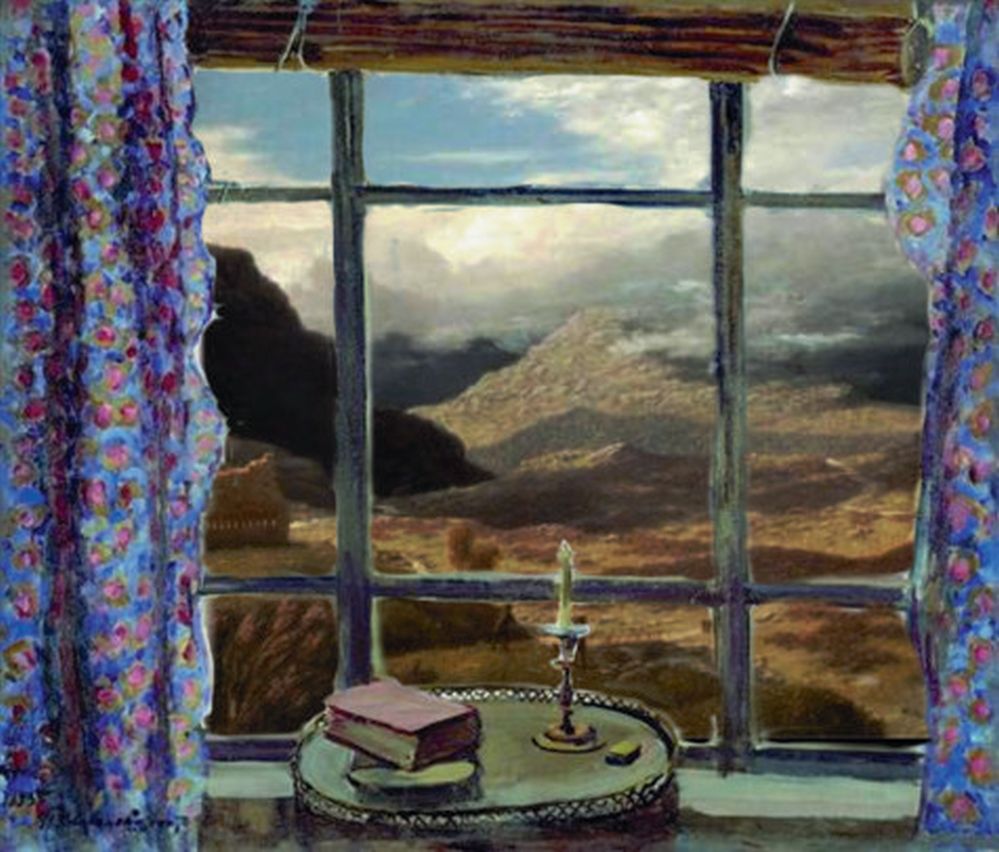
This digital image frames a wild Highland landscape through the quiet intimacy of a poet’s window. A small table, books, and a single candle suggest reflection, solitude, and the old companionship of reading, while the mountains and mist beyond the glass open the scene into memory and legend. The patterned blue curtains add a domestic softness to the rugged view, creating a gentle contrast between inner life and the vast, storied world outside.
Girl Reading by a Brook
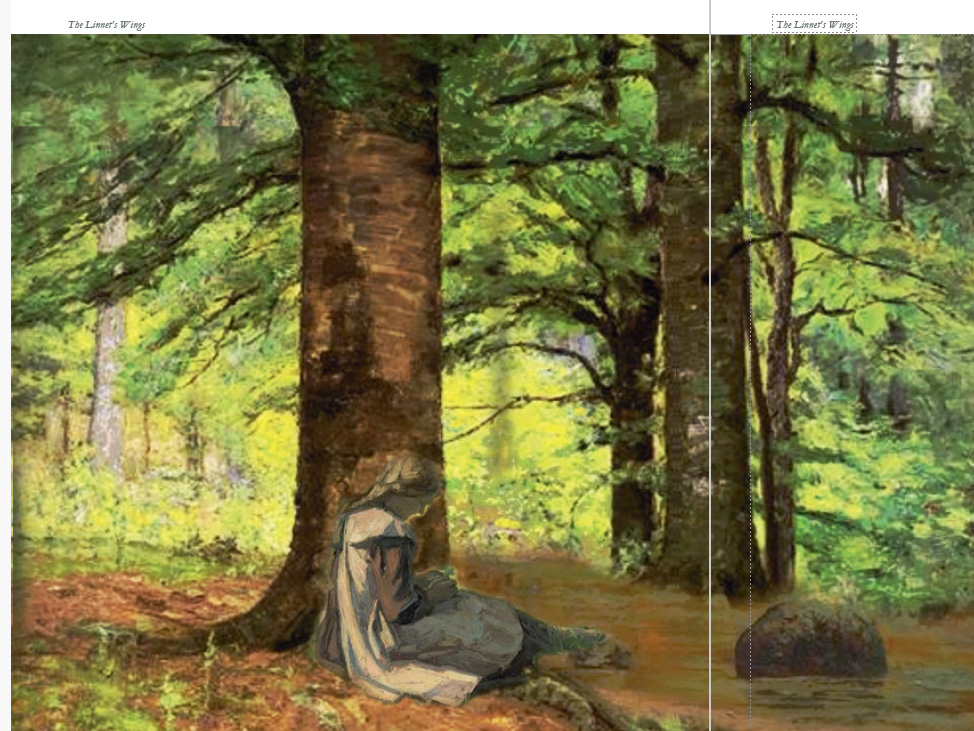
A digital image made in photoshop of a girl sitting by a tree and reading by a slow flowing stream
Marie Fitzpatrick
Marie Lynam Fitzpatrick’s Girl Reading by a Brook is a quiet digital composition set in a deep green woodland. A solitary girl sits beneath a broad tree, absorbed in her book beside the soft movement of water. The layered forest light, mossy ground, and shadowed brook create a feeling of shelter, stillness, and private imagination, as though reading has opened a secret place within nature.