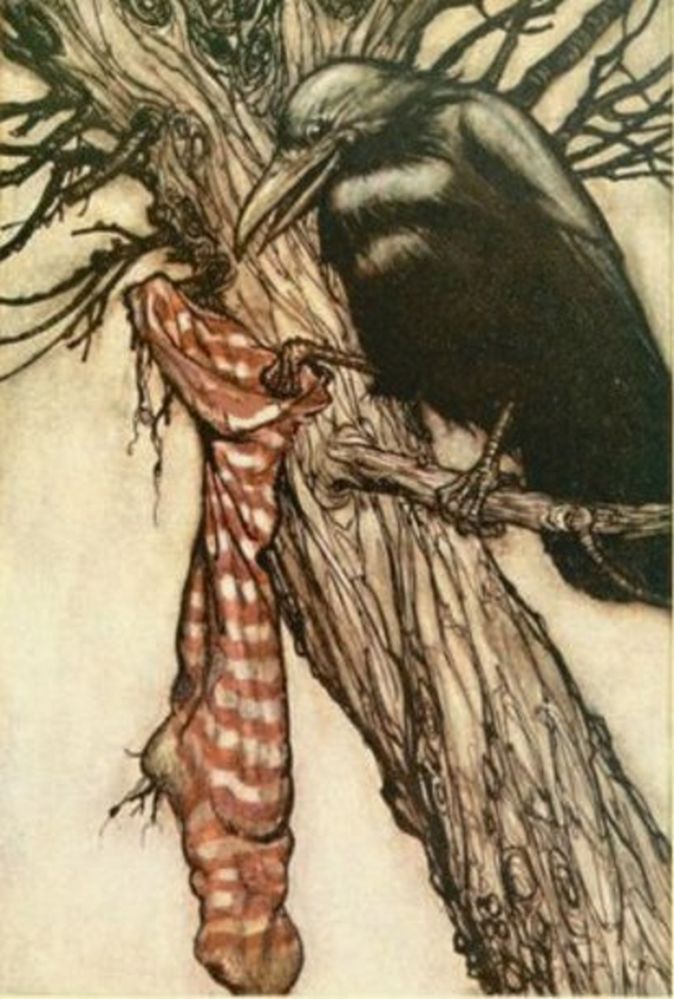
Illustration by Arthur Rackham: For Years he'd been quietly filling his stocking
Grandma, surrounded by papers and pictures, looks down at Archie sitting on the floor with his head resting on her sofa, “let me tell ya how it was, our circus was called the mud show because the roads we traveled on were often knee-deep in mud. The wagons were always getting stuck, breaking down or turning over. The first night out of Topeka my wagon turned over three different times. I decided to walk to Emporia after that. When a wagon turned over it was hell getting it back on its wheels, especially after dark. We almost always traveled at night. For light we had kerosene lamps hung on the wagons. Sometimes the men would walk ahead and plant flares at the crossroads so the caravan would not lose its way. Every trip was long, lonely and miserable. But it was all worth it when we got to a town.
No matter how dirty and beat up and tired we were we always rode into town like royalty. We always found a river or some kind of pond to wash up in. Then, dressed in our most magnificent uniforms, we would march into town with our trumpets blaring to alert everybody that we had arrived; it was circus day. We would march right through the middle of town with the kids, dogs, and even grown-ups dancing beside us. At the edge of town we would park the wagons, unload them, and start setting up the Big Top.
Everybody in those little towns took the day off when the circus was there. The children were let loose from school and chores. It was the biggest holiday of their lives. I was new but I got over that real quick. The owners, Tim and Marg Blankenship, took me into their tent and treated me like their own daughter. My first job was selling tickets. I was scared to death but before the first day was over I was in heaven. People would come to the ticket window all smiling and happy. I smiled back and talked to them like I had known them forever. And they loved to talk to me and listen to me; I fit right in.
When the tickets were all sold I would close up and run into the Big Top. I was always looking for some way to help out. And after a few weeks everybody in the circus knew me and gave me jobs. I become so busy I didn’t have time to be lonesome or unhappy.
As time went on and we traveled from town to town I even replaced some of performers. Once I took the place of the girl who worked with the knife thrower. He told me to not be scared, just keep my eyes open and watch the knives coming at me and jump out of the way if any looked like they might be too close. I wasn’t scared and I kept my eye on those knives.
We had about thirty people working for the circus and I got to know them all. It was the best time of my life except for one thing, Tom. Tom was friends with everybody and he was always working. But he never talked to me or even looked at me. He was the boss of the roustabouts and he got right in and worked along side them. He drove the big wagon with ten reins in each hand and pulled by twenty white horses; it took a strong man to do that. He was a champion bicycle racer; it seemed that there was nothing he couldn’t do. He even did some of the trick riding and getting up on the high wires to catch the trapeze artists. I sneaked into one of the sideshows to watch Tom fight in the boxing ring. He was so brave; one night he fought eleven locals one after another and made them all quit. He said he would give twenty dollars to anybody that could last three rounds; nobody ever did. I read the “Police Gazette” and later on “Ring Magazine” and learned all about boxing. I wanted to be a boxer but they would have laughed me out of town if I were to tell anybody.
The Blankenships had a farm down in San Antonio and we would winter down there. I liked “wintering.” We could relax, do repairs on the equipment, mend our costumes, and practice our acts. I become a clown and I was a good one. Shorty Van der Berg took me under his wing and taught me all the tricks of the trade. I was on my way to becoming a star and still Tom wouldn’t look at me.
One day Tom was driving across a creek and the bridge collapsed. The wagon fell on top of him and was holding him under the water. I grabbed a tent pole, waded into the water, and pried it up enough for him to slip loose. I saved his life and he started talking to me again. One day I just up and told him we had to get married. And we did.
He didn’t want me to be a clown no more so I told him I’d quit clowning if he let me be his sparring partner. He didn’t like that either but I had my way. I showed him a trick or two with the boxing gloves that I learned just by watching and he looked at me with new eyes.
Tommy was born one winter and Lonnie the next. Those boys took to circus life even faster than I did. They was everywhere and getting into everything; the cook said he never seen two humans eat so much. Tommy watched his dad fight and that’s all he ever wanted to do, be a fighter. Lonnie was interested in fixing things; he wanted to be a blacksmith. They went to school here and there but mostly they played hooky. I didn’t have the heart to make them go to school. Back in those days book learning wasn’t so important.
The boys were still little when we heard about automobiles—horseless carriages. We all laughed about that and didn’t believe it. We thought it was a hoax the big shots were pulling on us yokels. Then Mr. Blankenship bought one. The damn thing made a lot of noise, smoked a lot, and backfired incessantly but it went faster than most horses. Tommy and Lonnie took right to it and learned to drive in a few hours. The older folks never did get the hang of it. I learned to drive right away but Tom wouldn’t even try. He said it was the devil’s own contraption.
Those first automobiles needed somebody to be fixing them all the time ‘cause they were always breaking down. Lonnie was just a little kid but he jumped right in and did what needed to be done to get that heap of bolts going again. He was the first automobile mechanic in our part of the country. Everywhere we went he would show folks how to get their cars going. He became famous as an auto fixer-upper and he was only a little kid.
Chapter XII
Grandma Johnson’s voice drones on as she continues her rendition of Lonnie’s killing of Todd Toolbee. Archie’s mouth is zipped tight as his eyes transfix Grandma while he grabs and translates the unintelligible words.
“After Lonnie was born I went to work teaching Tommy everything I could. I even put the gloves on and traded punches with him. At first he cried when I tagged him but he got over that early on. When he was half my size he begin to get the better of me. I decided to stop sparring with him before he found out he could whip me. Tommy always respected me though. He never said mean things to me like I hear some of today kids saying to their ma and pa.
Lonnie was the funniest kid anyone could imagine. Soon as he started crawling he was all over the place, getting into everything. Tommy looked after his little brother until Lonnie got big enough to want the same things as Tommy then we had some rip-roaring squabbles. I laughed so hard my sides split when I saw happy, good-natured little Lonnie refuse to back up when big Tommy was trying to push him around. I guess Tommy could’ve really hurt him but he didn’t want to. Lonnie, beautiful little Lonnie wasn’t scared of anything. They started boxing almost as soon as Lonnie learned to walk. I always said Tommy was a born fighter and Lonnie had to be taught. But I was wrong Lonnie was a born fighter all right. It’s just that he tried to be reasonable and saw fighting as the last thing that should happen. Another way to look at it: Tommy had to fight and Lonnie would be happy if he never fought again.
We soon had a regular sideshow, the Johnson brothers boxing each other. They put on a good show and often the tent would be filled with people screaming for the little fellow. It was good business but looking back on it I come to believe that must of tore Tommy up because he was always looked at as the bad guy.
When Tommy was fifteen or so he teamed up with Tom. Together they would challenge all comers to last three rounds with one of them for twenty dollars. Of course Tom wouldn’t let Tommy fight anybody that weighed more than one hundred and forty pounds. He also looked over any opponents before he would okay a match with his son. I don’t think he turned down anybody because they looked too tough or too good. This didn’t last more than six months or so because Tommy never pulled his punches. He’d just storm out throwing both fists like a mad man and send some poor citizen crashing to the canvas with broken bones and concussions. Tom tried to get him to take it easy but he never did. Finally, Tom sent him back to look after the horses; his circus fighting days were over.
We got new acts all the time. Some lasted and some didn’t. About the time Tommy got demoted to the stables a daredevil motorcycle rider joined up. His name was Count Von Ridenhower, a made-up name if I ever heard of one. He had a fake German accent and an eye for the ladies. I never saw such a phony in all my life but he fooled a lot of people. Especially some of the nitwit dancers we had that come and go all the time. He was a real daredevil though; his act was the most dangerous we had and motorcycles were new to most people so the crowds flocked to see him perform. Lonnie followed him everywhere and it wasn’t long before he had my little boy on that dangerous machine. I tried to stop it but I might as well of tried to fly to New York.
One day Tommy was missing. We asked around and found a man in town that told us Tommy told him he was headed to New York City to be a professional prizefighter. We had circus people search for him but he never showed up in New York or anyplace else we could think of. It would be years before we heard from him.
Lonnie took Tommy’s place in the ring and he was a natural. He was so good from the very first time. He wasn’t very tall and Tom thought he was never going to be a circus fighter because of that. But Lonnie had this way of just slipping and sliding and not giving his opponent any target. I swear he won fights without throwing a punch. And nobody got hurt when they got in the ring with him. He would just let them wear themselves out trying to hit him and then he would ask them to give up. They usually would quit but if they didn’t he’d drop them with a shot to the belly. Like I said nobody had anything to fear when they boxed Lonni The years rolled along and it never got any easier; it seems like there was always some kind of crisis that kept us broke and searching for some way to keep the circus together. Payroll was a big headache but the Blankenships always managed to meet it some way, somehow. I can’t say the same about some of our suppliers; we slipped out of more than one little town owing money. We were always talking about buying more trucks and getting rid of the horses and mules but we never did. We thought that the highways would always be too bad for motor vehicles. We had an elephant once—old Barney. We loved him. He could pull or push a wagon out of any mud hole ever born. He was better than our truck when it come to raw muscle. I laugh because he liked his whiskey and he drank a lot of it.
Lonnie was twenty-one or two when we set up the Big Top in Conway Springs. By this time he was working at more jobs than his pa. That boy was the mechanic, truck driver, fighter, and by this time, he was our daredevil motorcyclist. On top of that he was always on the go helping out wherever he was needed. I don’t know how he managed but he started sparking a farm girl. She was from a farm over near Wichita and visiting a cousin. She was only sixteen but damned if they didn’t up and get married. I was dumbfounded but I don’t know why because I was about the same age when I married Tom. Yes, Archie, that was Molly that Lonnie married.
Lonnie and I didn’t know it at the time but that marriage saved us from the poor house. It wasn’t more then six months later that Tom took sick. We called in a doctor but the doctor couldn’t figure it out. He was an old-time doctor but he never saw anything like what Tom had.
Tom just lay there and we watched him die. We carried him out into a field and buried him. The preacher was saying a prayer over his grave when Lonnie screamed and run off across the fields.
We, Molly and me, didn’t know what to do so we just when home. The next morning the sheriff come and told us Lonnie was in the hospital. It seems that during the night he come back to the circus and pushed his motorcycle out into the countryside and started riding it at top speed. Of course he crashed it in the dark and tore his leg all to hell. The hospital wanted to saw his leg off but I wouldn’t let them. Molly and me picked him up and carried him out of that hellhole. We got in our buggy and went back to the circus but we couldn’t stay there because they couldn’t afford to have anybody around that’s not working.
We decided to go and see if Molly’s folks would take us in. Her ma and pa were the nicest people I ever met. They said we could stay as long as we needed to. It was a long time because it seemed like Lonnie was never going to get well. We must of stayed two years and Lonnie still wasn’t getting around very good but we decided to leave anyway. We went to Topeka and Lonnie got a job working for an automobile repair shop. We stayed there for ten years and was better off than we ever thought possible. Andy and Paulie were born in Topeka.
It’s a funny thing I was living in the town where I was born and raised but I never felt I was a part of it. I never went back to visit the Emma Broward home because it just didn’t seem right. I saw the Spauldings go by in their carriage but they never saw me. I was a stranger in my own hometown. Molly and Lonnie were working all the time so I was left to take care of the boys. Andy was a lot of fun but Paulie was a hostile little bugger.
When Andy was ten and Paulie was six all the money dried up so Lonnie was laid off. We didn’t know what to do ‘cause Molly’s housekeeping job didn’t pay enough to feed us. A man come by and said they needed a mechanic in California so Lonnie sold everything, bought an old car, loaded us up, and it was, ‘California here we come.’
We got out here and Lonnie, busted up leg and all, went to work right away. It wasn’t long before he was the top mechanic in the shop. Then the depression that we left behind in Kansas finally got to California. Soon, he was the only mechanic left because all the others were laid off. The boss, Ross Manning, really liked Lonnie so he kept him on but had to cut his pay. Lonnie, to keep food on the table, had to work night and day. I remember the night of the killing like it was yesterday. It was a Saturday night and Lonnie, after working all day, went back to the shop after supper to finish a job. It was after midnight and Lonnie, except for supper, had been working since five o’clock that morning. He was all by himself when all hell broke loose.”
Grandma begins rummaging through the trunk. “Some newspaper reporter wrote a story about the Toolbee family. If I can find it I’ll let you read it, Archie.” She pulls a newspaper clipping from the trunk and hands it to Archie.
Archie reads the headline:
An American Success Story Tainted by Tragedy By Scott Mallory
Caleb Toolbee came from the hard-scrapple oil fields of Pennsylvania over fifty years ago. He is known as a hard man with a dollar. The first to find that out was Sol Goldburg. Sol was the proprietor of the only hardware/farm implement store in town but it was a struggling business. He took the young Caleb in as a partner and within five years business was booming, expanding. Sol never profited from the success and soon found himself pushed out of the ownership. He died a broken man.
Caleb had found the formula for success and a wide variety of businesses fell into his hands in the years to follow. The most notable was the fertilizer industry. Before Caleb, an eastern company, Moss Hunt Inc., dominated the valley market. Caleb established his own corporation and used his, by now, vast resources to undercut prices. Moss Hunt was forced out of California and San Joaquin Fertilizers Inc. has enjoyed a virtual monopoly since that time.
Caleb Toolbee’s monumental success didn’t spill over into his private life. He lived alone in a large mansion with but a single manservant. His acts of charity were non-existent. He refused to talk about family. When asked directly his reply, “They’re all dead and in hell.” His employees were not spared; he hired and fired frequently. There was concern for his estate when he passed on.
In the winter of 1920 he took an unprecedented vacation. He was not heard from for three months and when he returned he had a bride. She was a beautiful woman and clearly thirty years younger than her husband. Her name was Consuela Obregon. Rumor had it that she was an aristocrat from Spain. We never knew because she was reclusive and neither she nor her husband was forthcoming about her background.
One year later she left town, some say she went to San Francisco, and when she returned she was trailed by a nanny carrying a tiny child. The child was a beautiful blond-haired boy. Caleb, for the first time in everybody’s memory, showed joy and happiness. He was an attentive father and doted on his offspring who he christened Todd. Observers noted that the new mother did not share her husband’s celebration; she was cold and even hostile towards her son. Within days she disappeared and was never heard from again.
If Caleb Toolbee was troubled by his wife’s disappearance he never showed it. Rather, he poured himself into the care of his son even to the point of neglecting his business empire. The first four years of Todd’s life was fun and games.
At age five Caleb entered his son in kindergarten and the trouble began. The teachers were perplexed, he was a beautiful child and had a bright happy smile but he couldn’t be trusted with other children. He wanted to hurt anyone smaller than himself. Not just pain, but serious injury was imminent for any child unfortunate enough to get within reach. Characteristically, Caleb blamed the teachers and classmates for the problem. He even suggested that the parents of victimized children were somehow at fault. He hired a tutor and removed Todd from private and public school.
The years passed and the boy grew tall, muscular. He retained his splendid good looks but the problems persisted. Time after time complaints were made, the police called, and each time victims and their families had to be bought off. Caleb finally decided that he had to take some drastic measures. Todd was sent to a military academy in Pasadena. He walked away after two days.
Back home, he hooked up with two of his friends. They purchased whiskey and proceeded to drink as they walked the streets. They became loud and abusive challenging passers-by to fight. Nobody accepted the challenge so they entered a saloon on Ninth Street. The bartender cautioned them to keep to themselves and avoid the party in progress. They retreated to a booth away from the festivities and proceeded to drink the night away.
It was a half-hour to closing time when a woman approached the cigarette machine to buy cigarettes. Todd leaped to his feet and wrestled the woman into the booth. This was witnessed by several patrons and soon all the partygoers were alerted. An army of men armed themselves with pool cues and sundry other weapons and confronted the trio. Todd’s uncontrollable temper was suddenly controllable. He apologized and with good grace he and his companions exited the establishment.
Back on the street Todd was furious and promised someone was going to pay for this gross insult. The streets were dark, deserted not a soul to be seen or heard. As they walked by an alley they saw a light shining from an open doorway. They entered the alley and were soon standing next to a garage with the backdoor wide open. Inside they could see a short stocky old man with a bad limp working on an automobile. He was oblivious to everything but the car right in front of him. Todd led his companions inside where they surrounded their target. This is the conversation that followed according to court transcripts: Todd standing directly behind Lonnie said, “Working kind of late aren’t you?”
Lonnie jumped and he turned to face his visitor. “Dang, boy, ya give me a start. How long you fellas been standing there?” His eyes took in all three as he sized them up.
Todd laughed a scornful evil laugh. “We’ve been here long enough to see you’re not much, old man. You should be more careful about leaving your door open at night.”
Lonnie smiled. “You come here to rob me?”
Todd was really grinning now. “Rob you? Hell, you haven’t got anything I want. You’re pathetic. I could buy and sell you with the change I carry in my pocket. No. We’re not going to rob you. We’re going to break both your arms and that one good leg you got. We’re going to…” Lonnie buried his fist into Todd’s belly, spun him around, and sent him flying into the alley with a shoe to the seat of the pants. Luke Hobbs and Bob Michaels, Todd’s friends, never raised a hand before Lonnie rendered them helpless with blows to the groin and throat respectively. Now, he walked each to the door and flung them out. Before Lonnie could close the door a rampaging Todd smashed it wide open. A knife was flashing back and forth aimed at Lonnie’s face. Lonnie threw his arms in the air to ward off the blows as he was driven across the garage. He backed into the workbench on the far wall and could go no farther. Todd had a wild gleam in his eye as he lowered the knife to gut level and moved in to disembowel his cornered prey. Lonnie reached back and grabbed his heavy mechanic’s hammer, and smashed it down on the top of Todd’s’ head crushing the skull. Lonnie, both arms bleeding profusely, collapsed and fell to the floor beside his dead foe.
“Gee Grandma sometimes you talk just like those high-falutin’ folks.”
Grandma laughs and taps her forehead. “I told ya, Archie, I got it rit rite cher and I could ditch my hillbilly talk tomorrow but folks would say I was gittin’ stuckup.”
Archie is puzzled but decides to press on. “What happened next, Grandma?”
Grandma pulls out a newspaper clipping with big black headlines; “CALEB TOOLBEE’S SON KILLED BY AUTOMOBILE MECHANIC!” Archie reads quickly until he gets to the part where Caleb Toolbee says he is confident that American justice will prevail and execute this murderer. “Why’s he say that, Grandma?”
“Folks that lose kin always want revenge. Old Man Toolbee tried but he never was able to get the law to make Lonnie go to trial. Folks like him never give up though and Lonnie will never work in this town ever again.”
“Why not go to Tracy like my mama did?”
Grandma shakes her head, “Lonny was tore up that he killed somebody. That boy ain’t never gonna work again.”
###
|