The program Popup.php is being run here but it is not available.
Editors at Work: Editorials/Forewords
On the Scots Language and Its Poetry by James Graham
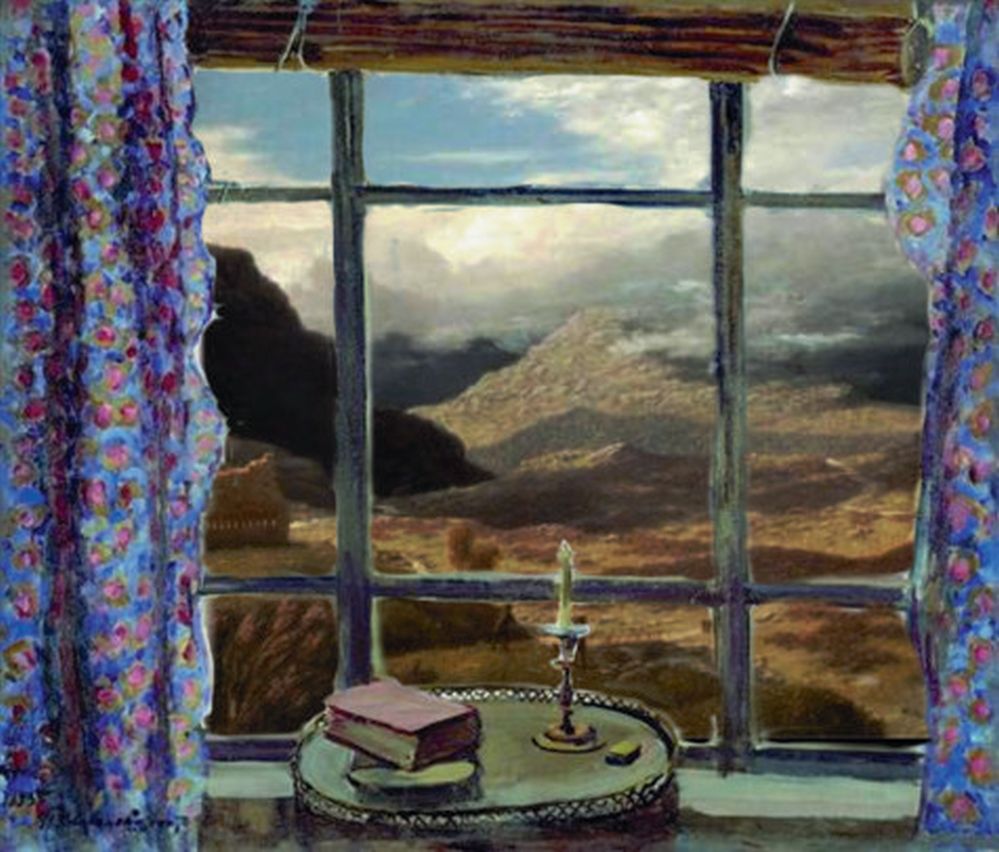
The Poet's Window by Marie Fitzpatrick
'Anent the Scots Leid an its Makars' |
Big Plans by Nonnie Augustine
Jane was propped up on her elbows, eating a slice of pizza and trying not to get sauce on her friend's bed. Caroline, sitting at her computer with a slice in hand, complained yet again about submission guidelines. |
Summer 15: The Cat and the Moon by Oonah V Joslin
-- and what it meant to Me (Poetry Editorial,)
by Oonah V Joslin
When I was little I had difficulty learning to read, partly because of left/right handed confusion, partly because I had a teacher from hell who used to pull my plaits when I made a mistake and maybe because it was around that very time my father died and upset the whole applecart. However it may be, all through junior school that part of the day when you went up and chose a book and read silently was a torture for me. But it led me to poetry. Poetry was short enough you could just dip in. Poetry had rhythms and rhymes that helped with difficult words (though I remember consistently reading 'phase' as 'face' in this poem.) Poetry painted pictures in my head that replaced all those confusing symbols with sounds and you could make up your own stories round it.
Recently I decided to repair an appalling gap in my reading and picked up a collection of Yeats’ work in a second hand book shop. We'd 'done' a few poems by Yeats at school but not many. However I wasn’t far into it before I recognised an old friend and I sat grinning with the book in my hand and remembered reading this one poem again and again (until the teacher spotted that I’d been in the same book for months that is) and the sheer delight of it because I loved cats and the moon and could see Minnaloushe pouncing about in moonlit pools.
The cat went here and there
And the moon spun round like a top,
And the nearest kin of the moon,
The creeping cat, looked up.
Black Minnaloushe stared at the moon,
For, wander and wail as he would,
The pure cold light in the sky
Troubled his animal blood.
Minnaloushe runs in the grass
Lifting his delicate feet.
Do you dance,
Minnaloushe, do you dance?
When two close kindred meet.
What better than call a dance?
Maybe the moon may learn,
Tired of that courtly fashion,
A new dance turn.
Minnaloushe creeps through the grass
From moonlit place to place,
The sacred moon overhead
Has taken a new phase.
Does Minnaloushe know that his pupils
Will pass from change to change,
And that from round to crescent,
From crescent to round they range?
Minnaloushe creeps through the grass
Alone, important and wise,
And lifts to the changing moon
His changing eyes.
by W B YEATS
And I remember thinking at the time that though the cat loved the bright moon and the moon shone down on the antics of the black cat, they could never really meet and understand each other. She is beautiful sacred and pure and very far above him and he will never be interested in dancing but only in hunting. Though they meet in the night, they really don’t understand each other’s natures or their own. It’s only the night they have in common, only the night that connects the two. They are both changeable and proud in their own way but they cannot accommodate each other.
Of course there is a lot more to the poem than that. A child can read it but it’s far from a children’s poem. Study it for yourself. The rhymes tend toward assonance and the rhythm inevitably breaks down. It’s a dance that cannot be. I knew nothing about Maud Gonne or Yeats himself or the moon’s 28 day cycle or much at all about anything (I think I was about ten). But that expression of solitude gave voice to something I sensed but didn’t understand, just as they didn’t understand; the nature of connectivity and individuality; the need to be alone commingled with the desperate longing to belong. The picture always remained in my head even though I didn’t know who’d written the poem. A great story of love and loss. And a good deal shorter than Anna Karenina!
Couplet Prologue, Summer 2015
Summer Couplets
Angels tune harps to small birds' tweets
While crows fix beady eyes on tasty treats
MLF
Summer displays directions
On footpaths of reflections
MLF
Happy is summertime all year round
The present is where happy is found
MLF
Summer creates scenes of fun and laughter
Joy and love and happy ever after
MLF
Summer scolds the pavement with its heat
Folks show tanned skin from head to bare feet
GH
The roar of May Bank Holiday
Motorbike psychology
OVJ
The worker's role we celebrate
Oh, what fun it generates
MLF
Summer came early and brought her toys to play
Sunlight and heat, she builds throughout the day
GH
Borodin conducted Liszt
Later, Mercury composed work they missed
MLF
Summer's musical number
Knit through man-made wonder
MLF
Summer whispers during Mercury retrograde
Communication errors will definitely be made
GH
Summer's love is clear and bright
It's communication at its might
MLF
Summer sun beats down relentlessly
He bakes the land and boils the sea
GH
When rag-and-bone men made their play
Lads and lassies, well! they made hay
MLF
A churning sea now settles down
For sun and fun as life rebounds
MLF
Summer clears away the cobwebs of my mind
And exposes dark corners -- what will I find?
GH
Well done to Spring, she cleared webs out,
Now Summer calls: a bottle of stout
MLF
I found in summer my life's refrain
This kiss of joy brought many gains
MLF
Exotic jasmine dances in on summer breezes
She caresses my face -- my soul she teases
GH
Sun scents sound, in air so still,
And seeds beauty for one's mind to refill
MLF
A tease, a dance, a summer breeze
Enough to create hearts of ease
MLF
Those damned birds singing at the screech of dawn,
Yawn, yawn, yawn, yawn, jaw-breaking YAWN!
OVJ
That early, easy bird song awakes
Oh man, oh man, I LOVE summer daybreaks
MLF
What light through yonder window shines?
It is the sun? Yawn, yawn!
OVJ
Let me up and out, there's road for action
This day ahead brings perfecto faction
MLF
Summer days, a freckled haze
Hide from those ultraviolet rays
OVJ
Just great, sunscreen down in the shop
It's sixty-, seventy-degree sunblock
MLF
(
Writers: Oonah Joslin, Mari Lynam Fitzpatrick and Ginger Hamilton (Writing on Facebook, Spring 2015)
Seamus Heaney: An Archaeologist of the Soul by Oonah V Joslin
Foreword Autumn 2013
They asked me to write something about Seamus Heaney and I thought, 'Who am I to do that? Sure, he’d never heard of me and I never met him.’ Still, when he died I felt sorrow for the loss and referred to him as a great poet and fellow countryman and I recommended people read Beowulf. Then I thought, 'Maybe my reaction itself bears some scrutiny.’
Great poet, undoubtedly. Such men never really leave us. Fellow countryman? You take the Ahoghill Road from Ballymena through Portglenone to Bellaghy and it’s only about twelve miles. But twelve miles and fourteen years and Heaney’s Ulster was a bit different from mine. He was a Catholic from County Londonderry (which he would have called Derry). I was Ballymena Baptist with 'orange’ blood in my veins.
And why Beowulf?
Heaney was out and out, an Irish poet and I do not consider myself so. In Ulster parlance we dug with the opposite foot. So let us pick our way you and me, over this splintered field of broken green glass and find out what made us fellow countrymen.
I’d picked up Beowulf before and tried to read it, not in its original form of course. Much as I wanted to, I couldn’t get on with it at all. I’d studied French as Heaney did and it seems we’d both cut our teeth on Hopkins and Eliot at school. We had that in common. Heaney however had the benefit of learning Gaelic because his education as a Catholic was culturally Irish so he developed a broader linguistic palate. Yet for him the language of Ulster was riches enough.
When I picked up Heaney’s new translation and read: “Afterwards a boy-child was born to Shield, a cub in the yard, a comfort sent by God to that nation. He knew what they had tholed, the long times and troubles they'd come through I grinned. “tholed" is just the word I would have used but it apparently comes from an old English word that begins with a letter shaped like a thorn.
I read on.
“That was one good king"
I smiled again. Later on there was:
“hirpling with pain,-- and there was “blather," and “gumption," and “hoked," and I read on and on delighted by the little treasures of my past.
I read about the great hall:
“The hall towered,
its gables wide and high and awaiting
a barbarous burning. That doom abided,
but in time it would come:
the killer instinct unleashed among in-laws,
the blood-lust rampant."
and I knew that he was talking about all divided peoples everywhere.
It was only later that I read in the introduction where Heaney talked about his family, the Scullions and their voices and words that had woven their way into this poetic narrative. He wrote that:
“The place on the language map where the Usk and the uisce and the whiskey coincided was definitely a place where the spirit might find a loophole, an escape route from what John Montague has called, 'the partitioned intellect’
That struck a chord with me. I know the River Usk too having lived in Wales. But you see
I do not consider myself an Irish poet. I am not an English poet either. I could perhaps be termed a Scot in the original sense of that northern part of Ireland being where the Scots came from (the Picts being from Scotland). Maybe going back far enough, I could call myself Dalriadan, being from part of that ancient Northern Kingdom that encircled the Western Isles. There is this innate identity crisis in all subjugate peoples; divided loyalties, cultural chasms, religious rifts and it’s difficult to find where you stand in an entrenched landscape dug by history. As I have said before, “difference is very persistent in getting the upper hand'
Heaney promised he’d dig with his pen but for me he did more than that. There’s digging and digging. Some people dig nothing but dirt, others dig graves and there has been a lot of that in Ireland’s history. Seamus Heaney endeavoured, like so many of us, to be part of the solution not the problem. In digging deep within the roots of our language, he excavated for us a rare treasure; the key of a kingdom. He reinterpreted the map of, as he put it:
“that complex history of conquest and resistance, integrity and antagonism… ..that has clearly to be acknowledged by all concerned… if we are to move forward.
Well, I shifted my position a bit and I owe him that. For is it not true that no matter who we are, we have far more in common with each than the total sum of our differences? He did the spadework for me. I understood Beowulf and myself and my history a bit better and in the splintered landscape of broken green glass, I look up and there are the old signposts: Ahoghill, Portglenone, Bellaghy with such familiar sounds and maybe next time I'm home, I’ll visit.
Thank you my fellow countrymen at The Linnet’s Wings for the privilege of paying this little tribute.
###
"Now he belched forth flaming fire."/An illustration of Beowulf fighting the dragon that appears at the end of the epic poem./Marshall, Henrietta Elizabeth (1908) Stories of Beowulf, T.C. & E.C. Jack, p.93
Oonah V Joslin is managing editor at Everyday Poets: www.everydaypoets.com
Prologue Summer 2013: Tender Buttons Gertrude Stein -- 1914
FOOD
SALAD DRESSING AND AN ARTICHOKE.
It was please it was please carriage cup in an ice cream, in an ice-cream it was too bended bended with scissors and all this time. A whole is inside a part, a part does go away, a hole is red leaf. No choice was where there was and a second and a second.
CAKE.
Cake cast in went to be and needles wine needles are such.
This is today. A can experiment is that which makes a town, makes a town dirty, it is little please. We came back. Two bore, bore what, a mussed ash, ash when there is tin. This meant cake. It was a sign.
Another time there was extra a hat pin sought long and this dark made a display. The result was yellow. A caution, not a caution to be.
It is no use to cause a foolish number. A blanket stretch a cloud, a shame, all that bakery can tease, all that is beginning and yesterday yesterday we had it met. It means some change. No some day.
A little leaf upon a scene an ocean any where there, a bland and likely in the stream a recollection green land. Why white.
APPLE.
Apple plum, carpet steak, seed clam, colored wine, calm seen, cold cream, best shake, potato, potato and no no gold work with pet, a green seen is called bake and change sweet is bready, a little piece a little piece please.
A little piece please. Cane again to the presupposed and ready eucalyptus tree, count out sherry
and ripe plates and little corners of a kind of ham. This is use.
OBJECTS
BOOK.
Book was there, it was there. Book was there. Stop it, stop it, it was a cleaner, a wet cleaner and it was not where it was wet, it was not high, it was directly placed back, not back again, back it was returned, it was needless, it put a bank, a bank when, a bank care.
Suppose a man a realistic expression of resolute reliability suggests pleasing itself white all white and no head does that mean soap. It does not so. It means kind wavers and little chance to beside beside rest. A plain.
Suppose ear rings, that is one way to breed, breed that. Oh chance to say, oh nice old pole. Next best and nearest a pillar. Chest not valuable, be papered.
Cover up cover up the two with a little piece of string and hope rose and green, green.
Please a plate, put a match to the seam and really then really then, really then it is a remark that joins many many lead games. It is a sister and sister and a flower and a flower and a dog and a colored sky a sky colored grey and nearly that nearly that let.
A TABLE.
A table means does it not my dear it means a whole steadiness. Is it likely that a change.
A table means more than a glass even a looking glass is tall. A table means necessary places and a revision a revision of a little thing it means it does mean that there has been a stand, a stand where it did shake.
A CHAIR.
A widow in a wise veil and more garments shows that shadows are even. It addresses no more, it shadows the
stage and learning. A regular arrangement, the severest and the most preserved is that which has the arrangement not more than always authorised.
A suitable establishment, well housed, practical, patient and staring, a suitable bedding, very suitable and not more particularly than complaining, anything suitable is so necessary.
A fact is that when the direction is just like that, no more, longer, sudden and at the same time not any sofa, the main action is that without a blaming there is no custody.
Practice measurement, practice the sign that means that really means a necessary betrayal, in showing that there is wearing.
Hope, what is a spectacle, a spectacle is the resemblance between the circular side place and nothing else, nothing else.
To choose it is ended, it is actual and more than that it has it certainly has the same treat, and a seat all that is practiced and more easily much more easily ordinarily.
Pick a barn, a whole barn, and bend more slender accents than have ever been necessary, shine in the darkness necessarily. Actually not aching, actually not aching, a stubborn bloom is so artificial and even more than that, it is a spectacle, it is a binding accident, it is animosity and accentuation.
If the chance to dirty diminishing is necessary, if it is why is there no complexion, why is there no rubbing, why is there no special protection.
A FRIGHTFUL RELEASE.
A bag which was left and not only taken but turned away was not found. The place was shown to be very like the last time. A piece was not exchanged, not a bit of it, a piece was left over. The rest was mismanaged.
ROOMS
A light in the moon the only light is on Sunday. What was the sensible decision. The sensible decision was that notwithstanding many declarations and more music, not even notwithstanding the choice and a torch and a collection, notwithstanding the celebrating hat and a vacation and even more noise than cutting, notwithstanding Europe and Asia and being overbearing, not even notwithstanding an elephant and a strict occasion, not even withstanding more cultivation and some seasoning, not even with drowning and with the ocean being encircling, not even with more likeness and any cloud, not even with terrific sacrifice of pedestrianism and a special resolution, not even more likely to be pleasing. The care with which the rain is wrong and the green is wrong and the white is wrong, the care with which there is a chair and plenty of breathing. The care with which there is incredible justice and likeness, all this makes a magnificent asparagus, and also a fountain.
A religion, almost a religion, any religion, a quintal in religion, a relying and a surface and a service in indecision and a creature and a question and a syllable in answer and more counting and no quarrel and a single scientific statement and no darkness and no question and an earned administration and a single set of sisters and an outline and no blisters and the section seeing yellow and the centre having spelling and no solitude and no quaintness and yet solid quite so solid and the single surface centred and the question in the placard and the singularity, is there a singularity, and the singularity, why is there a question and the singularity why is the surface outrageous, why is it beautiful why is it not when there is no doubt, why is anything vacant, why is not disturbing a centre no virtue, why is it when it is and why is it when it is and there is no doubt, there is no doubt that the singularity shows.
A whole soldier any whole soldier has no more detail than
any case of measles.
A bridge a very small bridge in a location and thunder, any thunder, this is the capture of reversible sizing and more indeed more can be cautious. This which makes monotony careless makes it likely that there is an exchange in principle and more than that, change in organization.
This cloud does change with the movements of the moon and the narrow the quite narrow suggestion of the building. It does and then when it is settled and no sounds differ then comes the moment when cheerfulness is so assured that there is an occasion.
A plain lap, any plain lap shows that sign, it shows that there is not so much extension as there would be if there were more choice in everything. And why complain of more, why complain of very much more. Why complain at all when it is all arranged that as there is no more opportunity and no more appeal and not even any more clinching that certainly now some time has come.
A window has another spelling, it has "f" all together, it lacks no more then and this is rain, this may even be something else, at any rate there is no dedication in splendor. There is a turn of the stranger.
Dance a clean dream and an extravagant turn up, secure the steady rights and translate more than translate the authority, show the choice and make no more mistakes than yesterday.
This means clearness, it means a regular notion of exercise, it means more than that, it means liking counting, it means more than that, it does not mean exchanging a line.
Why is there more craving than there is in a mountain. This does not seem strange to one, it does not seem strange to an echo and more surely is in there not being a habit. Why is there so much useless suffering. Why is there.
center>###
(Prologue Summer 2013)
Art Editorial Summer 2013
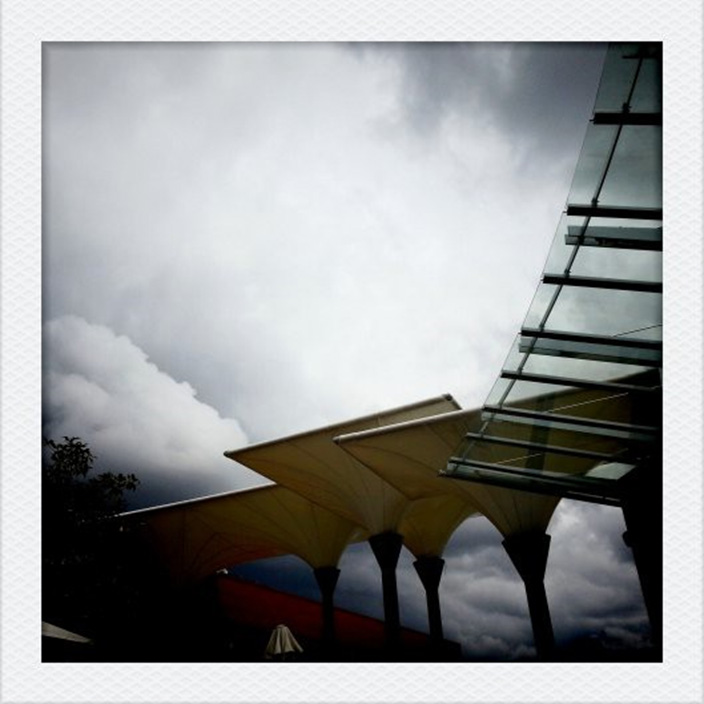
Thiais Village Credit: (c) Gabriel Mtz. Aguirre (c) Gabriel Mtz. Aguirre
Photo Gallery: Summer storms . . . . |
I Agree With William Blake by Nonnie Augustine
“Poetry fettered, fetters the human race. Nations are destroyed or flourish in proportion as their poetry, painting, and music are destroyed or flourish."
William Blake died in 1827, well before the rise of Hitler, Stalin, Franco, or Mussolini. But he knew, Artists do not flourish, at least not openly, when under the thumb of repressive regimes. Artists draw the eye and ear toward kindness, toward the careful tending of small things, toward the freedom each of us needs in order to flourish. I expect I'm preaching to the choir here, because you are reading this magazine, and so, I believe, you already value art, and because you are reading this introduction to the poetry section of The Linnet’s Wings, you read poems. (Somehow many people don’t, you know.)
How awful life would be, how fettered, if all we had to read were White Papers, financial reports, news of war here and there and everywhere, or heaven help us, the dictates of an autocrat. Have you heard Jimi Hendrix’s version of The Star Spangled Banner? It’s beautiful, heartfelt, and utterly free. There’s also warning in this version of the anthem; he’s rallying us to never let our guard down and always to look for deeper meanings even in something we think is established and therefore completely known. Artists do that for us, whether they lived centuries ago, or are just starting out with their brave, tender voices.
Let me point you toward some of my favorite bits in this issue’s crop of poems:
“Joe’s dovecote/ was a narrow spartan shed/ enough for/ thirty racing pigeons/ cozy on their perches"
Stan Long
“ The atmosphere of Scandinavian coolness/ is tempered by the Japanese aroma/ and visual pleasure of the cavalcade/ of ancient sacred food" John Saunders
“the fathomless deep greens/of fir and spruce, steadfast/ throughout the harsh resentment of winter"
Anne Britting Oleson
“When all of the jobs/ dried-up, you/ helped me sew together/ the pieces of my broken spirit./ Having faith in your own words, in us." Ivy Page
“From inside the closed balcony door the cat watched/ with surprising calm./ My heart beat too was calm./ For a short while I knew everything, with certainty." Beate Sigriddaughter
“that austere boyhood near London,/ lamp-posts disappear into fog,/ images reminiscent of Whistler." Ian C. Smith
As you know, in the U.S. we just went through a bitter campaign season and finally re-elected Barack Obama for a second term as our president.
I am relieved for many reasons, but mostly because I was so disturbed by the other guy and his cronies. In what they said, did for their livings and by how they measured success, I knew. I knew.
These are not men (almost all of them are men) who value the words of poets. They'd not relate to pigeons, cozy in a spartan shed. I do. I’ve been warm and content in the most drear circumstances while a student at Juilliard.
I sense that these politicians, so proud of their success as businessmen, might purchase a Whistler but only as an investment; a status symbol. Not me. I would go to a museum to sit happily in front of one of his paintings and maybe, for a short while, I would know everything.
The Linnet's Wings is free to you online. I hope some of you will buy print copies because they are beautiful. We editors commit to each issue our unfettered spirits and we bring you the work of writers who speak to us without fear, with their best, and in their belief that through art we all will flourish.
###
Poetry Editorial: A Mother Knows by Oonah V Joslin
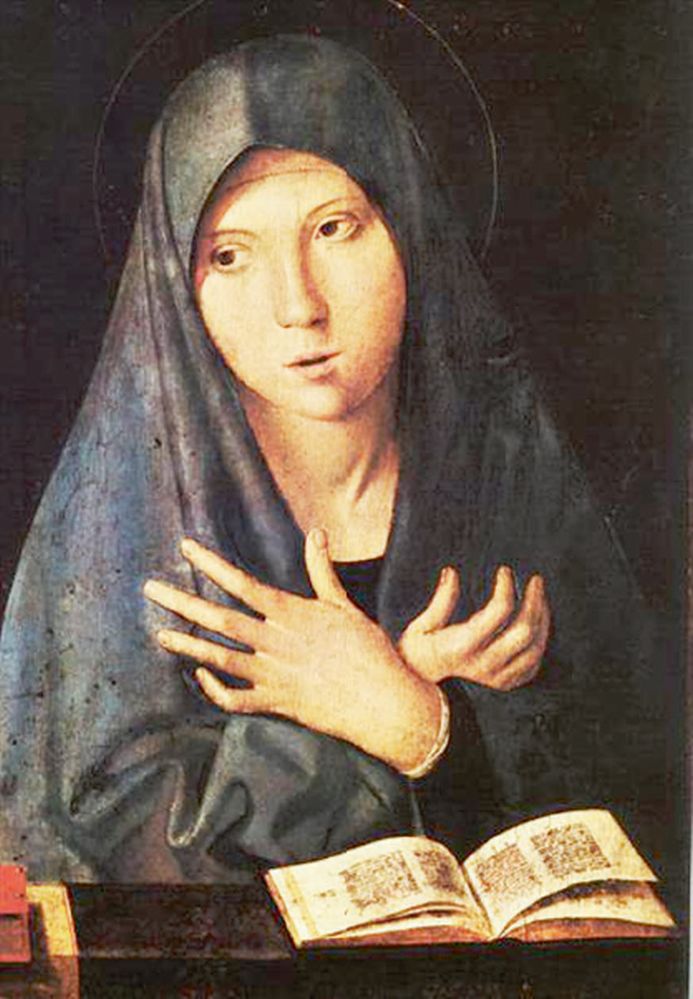
Virgin of the Annunciation by Antonello Da Messina
Autumn 2013 |
Slightly Mushy Essay About Poetry and Peaches by Nonnie Augustine
Indigo Frontis, The Linnet's Wings House Art
"Do I dare to eat a peach?" is a line in the penultimate stanza of T.S. Eliot's "The Love Song of J. Alfred Prufrock." He wrote it sometime before 1920, when it was published; I read it sometime around 1973 ; it has lived with me ever since. The line comes up, you know? Along the way, as I've done this or that, it's surfaced, throughout my adult life-as have other bits from this or that poem, but I'd have to go on and on and on to talk about all of them, and we don't want that. No. Just Prufrock's peach. Why has it stuck with me is what I'm wondering about here. |
Prologue-Vampires, Ghosts, the Dead Returned by Yvette Managan

Loup Garou, The Linnet's Wings Story Book
Vampires, ghosts, the dead returned, mad men - all these things our parents whispered to us, to entertain or warn us into obedience. |
I'm convinced Micro & Flash are fiction's future by Ramon Collins
Perhaps the future is already here because it's the way people today like to read. More newspaper readers read the personal ads and the comics than read the editorials.
Is it shortened attention spans? It might be a Pavlovian "conditioned response" after four generations of TV idiots. It could be the effect of today's mad dash to nowhere. Whatever, the crafts are here to stay.
In four to eight thousand word short stories the writer has time to describe the living room curtains and what the protagonist's Aunt Maud from Wexford had for breakfast, but not in Micro or Flash fiction. The writer can imply we're in the house and that someone's in the kitchen. What the living room or Aunt Maud looks like is up to the involvement of the reader's imagination.
In my opinion, that's the key to the Micro & Flash crafts; "involvement". With the writer's skill at inference and implication the reader is invited to participate in the story -- to become an onlooker inside the story who asks the characters questions.
These are not television stories where you're spoonfed plot, settings, characters and dialog. Please participate and enter ...
2007 Ramon Collins
The Poetry Connection by Nonnie Augustine
My namesake, my Nonnie, was a dream grandmother. She knew every nursery rhyme, every silly song, and read from Robert Louise Stevenson's "A Child's Garden of Verses," with the same joy with which I would listen. She may not have been as good at other roles in life as she was as a grandmother, but because of Nonnie, I excelled in Mother Goose in Kindergarten, and poetry has been a life-long love.
Later, I taught Kindergarten myself. The children I taught were misfits-emotionally disturbed five-year-olds, who were wild, withdrawn, violent, and to a child, oppositional. When it was time to sing songs, listen to stories, and recite poems together, they were well-behaved, happy, content classmates, who liked each other and enjoyed their young lives, more than at any other time of day. Children don't have to be taught to love rhyme and metrical language. They are fascinated with ditties like, "Ride a cock horse to Banbury Cross to see a fine lady upon a white horse. With rings on her fingers and bells on her toes, she shall have music wherever she goes," long before the words convey meaning to them. Try it. Bounce a oneyear-old on your knee, with and without a spoken verse or song, and see the delight in the child's face when he or she hears magical, metrical rhyme.
"I will arise and go now, and go to Innisfree." Do Yeats' words speak to a longing in you? I'd guess yes, that they do. He didn't say, "I'll get up and go to Innisfree." The meaning is the same-but there is no poetry in the second version. It is not a magnificent line, as is the first. Oh, yes. Our gift is that we recognize the music of language, we are hard-wired to, and we have been all our lives. We can understand meaning through metaphor, or listen to "'Twas brillig, and the slithy toves/ Did gyre and gimble in the wabe:," and glean much more than nonsense from Lewis Carroll's words.
Good modem poets often eschew forms and rhyme schemes from other centuries, creating their own structures, scansions, and devices so that their words will reach, again in W.B. Yeats words, "the deep heart's core." Craft, insight, emotion are needed to drive poetry to that place within us, as much today as during any other period of our human history. When today's poets do use the frame of a sestina or a villanelle, fresh, relevant, language is needed to anchor the lines in modem minds and souls. Poetry isn't only for poets. It is an important part of our humanity. Ask a baby and you will see the proof. --Editorial 2007 (Inaugural Webzine)