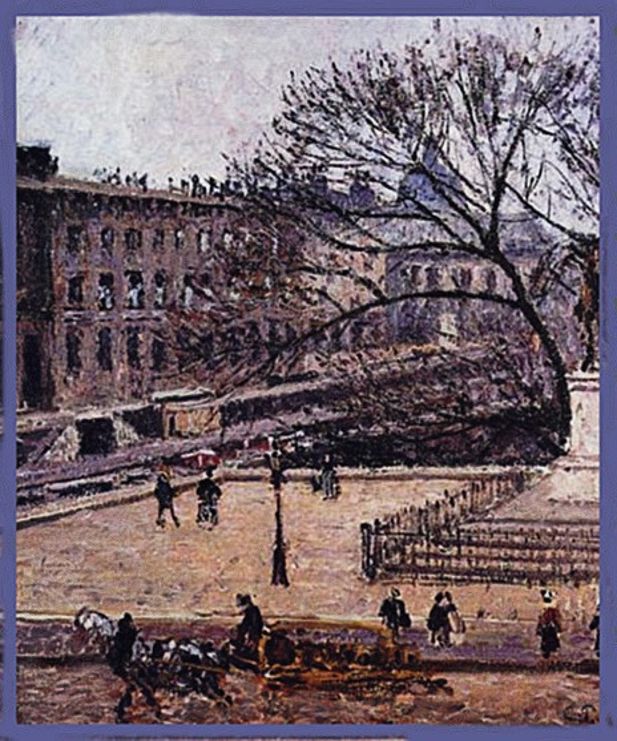
The Treasury and the Academy (Gray Weather) by Camille Pissarro
Camille Pissarro’s 1903 cityscape catches Paris in soft grey weather, its public buildings, trees, and muted street life forming a quiet atmospheric companion to the page.
The Treasury and the Academy, Gray Weather, 1903, by Camille Pissarro. Public domain.
Somewhere in his great chronicle of the poor, The Grapes of Wrath, John Steinbeck has his character Tom Joad say in a moment of despair, 'We take a beatin' all the time.' Ma Joad tells him: ‘Why, Tom, we're the people that live. They ain't gonna wipe us out. Why, we're the people - we go on. Don' you fret none’.
My family, on both sides, took many a beating. My maternal grandmother lost her first husband in the Boer War, her second at the Somme, and her only son in the bombing of Coventry. At the end of her life my father’s mother was working 12, sometimes 14, hours a day for a pittance. My father’s long, hard working life brought him little reward, and he was a wholly undeserving victim of disrespectful and often callous treatment on the part of his employers. It’s hard not to fret. Ma Joad is right, though. To fret in adversity is futile. We need to respond to poverty and its attendant calamities far more purposefully: with anger, determination and egalitarian values on which we are prepared to act. Having told Tom not to fret, Ma Joad adds: ‘A different time's comin'. But only if we make it happen.
This is the story of my father’s life, and the lives of those closest to him. Much of it speaks for itself; the hardship and injustice are self-evident. But I will not avoid the politics of it. Ma Joad’s ‘they’ who ‘ain’t gonna wipe us out’ are the capitalists, landowners and bankers, and the politicians who serve their interests. They may not wipe us out but they keep us down. They diminish our lives. We need to work towards a new society which has no place for them.
My father was never destitute, but he was a man who needed courage and perseverance to live the life he inherited. He was born in 1875, the youngest of twelve children—all of whom survived— in a farm labourer’s cottage in County Antrim.
He started school at the age of five and left when he was eight, able to read well but still struggling to write—a handicap that was to remain with him for the rest of his life. Even in his later years he laboured to compose a letter, not because he had trouble knowing what to write but because he lacked confidence in forming the words on paper. Eight-year-old Danny was hired out to a farmer who needed a boy, and thus he began a working life which was to continue almost unbroken until his death at the age of 76. He never retired.
When he was 15 his father died. For widows of country labourers this meant only one thing: notice to quit. Danny’s mother, Ellen Dodds Graham, decided to pack up, get on the boat at Larne, and move to Glasgow. As all of Danny’s eleven brothers and sisters were as well settled in Northern Ireland as could be expected, she took him with her, in the hope of a better life.
Their introduction to this better life was a ‘single-end’ in Parkhead in the East End of Glasgow. This was a one-room flat at the end of a tenement block, on the second floor, with an outside toilet down two flights of common stairs and through the back entry. The flat had been left in a filthy state, and Ellen had to clean it as best she could, from floor to ceiling.
To pay the rent they both had to find work. I don’t know how long this took or how difficult it was, but I imagine them walking the streets between factories, shops and council offices, asking if there were jobs available, being turned away, and finally succeeding. Ellen went to work in a rope factory, where the normal shift was 12 hours, extended at busy times to 14 or 15. There was a one-hour lunch break, but at least half of it was taken up with cleaning her machine, which was shut down only at that time. Her wage, if it was the average for the 1890s, would be 7 shillings (35p) a week, just under half that of male workers. Unsurprisingly, more women than men were employed. On Sundays, of course, much of her time would be spent in the wash-house.
This is the politics of it: Ellen and her fellow-workers were made to work as many hours as they could physically tolerate. Their employer bought their labour as cheaply as possible. The ropeworks was a capitalist enterprise. It functioned in the way Marx described. Workers were ‘alienated’, which means two things: they were alienated from the product of their labour, that is denied their fair share of the value of what they had produced, and alienated from themselves that is denied the ability to determine their own life and and destiny and live as fully autonomous human beings. Ellen had little or no choice as to where to live or how to live. She did not own a share in the value of the ropes that were sold to shipping companies and others. Keir Hardie was elected to Parliament in 1892, the first fully committed representative of the interests of exploited workers. But even the advent of decent wages and working hours was a long way off—and Ellen would not live to see it.
Danny’s job was, to put it over-politely, in waste management. He was the boy who helped the man who went round the streets in the early hours with horse and cart, collecting refuse from back-courts and taking it to the tip. A dirty, unpleasant job, but less arduous than his mother’s, I imagine.
Sometime around 1900, I don’t know exactly which year, Ellen Graham died. Her health had deteriorated; her heart was taking too much strain; in short, she was worked to death.
My father found a better-paid job in Parkhead Forge, a steelworks owned by William Beardmore—a famous man in his day, one much praised for his entrepreneurship. After working there for less than a year, however, Danny made a serious mist ake. A co-worker was trying to organise a trade union branch in the factory, and he agreed to join the organising committee. One day, without any warning, the members of the committee were called one by one into the general manager’s office, and sacked. My father remembered that the manager did not speak to him at all except to confirm his name. He simply handed him his ‘books’ and gestured to him to leave.
Some time after he lost his job at the Forge, he went to Middlesbrough—perhaps because there was similar work to be found there. This was where he met his first wife, Elizabeth Lord. I believe he had work there for a time until he was made redundant, then moved with his wife back to Glasgow. He found various temporary jobs but could scarcely make ends meet. Soon after, he made a decision that was to change his life: he found a job as a general handyman on a country estate in Ayrshire. Elizabeth (he called her Libby) may have been unhappy in Glasgow, and certainly weary of the struggle to stave off poverty, but my father had another motive: he wanted to be a countryman again.
They moved to a cottage on the edge of a beech-wood, six miles from the nearest town. My father began the tasks that would occupy him for the rest of his life: trimming—with hand shears of course—a mile or so of hawthorn hedge; hoeing and raking hundreds of yards of paths; feeding and grooming horses and riding them to the smithy; scything and gathering hay in season and taking it by pony and cart to the store.
His first boss was a decent man, but it was not long until he died and the Georgian mansion and extensive grounds were sold to a man who had inherited a fortune from his industrialist father. There is little to be said in this man’s favour. It may not be strictly true to say he never did a day’s work in his life, but it’s likely he did very few. He was a mineowner and slum landlord, taking rents from people who lived in tenement flats much like Ellen Graham’s in Parkhead. Later he acquired another business, manufacturing flush toilets and gents’ urinals, never a rival to Twyford but installed in conveniences around the country, with his surname Howie clearly printed on the product. For reasons I won’t go into in too much detail, I always took pleasure in using one of these. He was badtempered, quick to complain if a job was only 99% perfect, addressed my father—even after years of good service—with condescension bordering on contempt. He was a fascist in his politics, in two minds about Hitler but an ardent fan of Mussolini. Worst of all—at least in personal terms—he paid my father £3.00 a week, even after the Second World War when farm labourers were earning £6.00. In real terms this would be very little more than the pay he had received as a farm boy. Howie never deigned to give him a raise of even a meagre 10 shillings.
My father dealt with all this in his own way. His boss’s political views, frequently expressed, he put down to ignorance. He answered complaints by quietly insisting that he knew his job and no other man could do it better; the boss would walk away without another word. He did not lose sleep over this man; never punished himself by bottling up anger and resentment. The man was simply unimportant; the woods, the parkland and the horses were what mattered. Libby died in March 1936, and later the same year my father returned to Middlesbrough, proposed to her niece Lilian, brought her home and married her. My sister Mary was born, and died, in 1938, and I was born in 1939. By that time, my father was 64 (my mother 28). He went on working because if he retired the family would have been evicted. Until he died at 76, he worked Monday to Friday from 7.30am until 5.00pm and 7.30 till 12.00 noon on Saturdays—for half the wage of a farm labourer. My mother worked for most of this time as cook and housekeeper, afternoons and evenings, finishing at 8.00 pm or whenever the family had finally got through their several courses, for less pay than my father—woman’s wages, that is. Even with the extra pittance she earned, and even though the cottage was rentfree, I don’t know to this day how they managed.
Sometimes in the school holidays I would go to work with my father, usually in the afternoon because I was too lazy to get up for 7.30. I remember him working on a fallen tree, sawing it to make logs for the ‘big house’ fires. In his early seventies he used a heavy twohandled saw, intended for use by two men but which he managed singlehanded.
A pony and cart stood by; I picked up logs and loaded them on to the cart. I was often aware, even at 10 or 11 years old, that my father was very tired, not with a natural temporary tiredness that passed with a good night’s sleep, but a deeper weariness that slowed him down and never quite left him.
I remember him scything hay, raking and loading it—with my help, which didn’t make a great deal of difference. He had been told to finish the job that day, though it should have been given at least half a day more. Between the hayfield and the store there was a steep hill; I remember the pony stopping on the hill, unable to go any further. We got down from the cart and gently led him to the top, pausing now and then. ‘Daddy, this is too hard,’ I said. ‘Aye son’, he replied. ‘He’s killing horse and man’.
Not long after, he suffered a fatal heart attack. Had he retired at the usual age, perhaps it would have happened anyway. But it is hard to escape the thought that he was, like his mother, worked to death.
He did hard manual work almost without a break from the age of 8 until he was 76. He never received a fair reward for his labour, or the respect he deserved.
A few years later I was at university, in contact with ideas of many sorts, including political radicalism. I became a communist, partly through the influence of a Marxist history lecturer, but also as the meaning of my family history began to take shape in my mind. My father’s life, and that of the women in his life, especially his mother, perfectly illustrated Marx’s theory of Surplus Value.
Workers receive only a fraction of the value of the goods or services they produce. Put another way, out of every 8 hours a man or woman works, he or she is paid in wages only two hours worth at most.
The rest is taken by the capitalist. Certainly some of this is reinvested in the enterprise, but a great deal of it augments the owner’s personal wealth and that of his shareholders.
Well, as soon as you learn about Stalin’s crimes it’s hard to go on being a communist. But something remains to this day, in spite of Stalin: an ethos, a set of principles that (for me) cannot be invalidated. Up to a point I am still a communist, and refuse to write off the communist regimes of the past. Even in the blighted Soviet Union, the son or daughter of a rural worker could have a free education, all the way through university, and become an academic, a scientist or an engineer.
Opportunities for girls were virtually equal to those for boys. (My own generation in Britain had similar opportunities, thanks to the 1945 Labour Government.)
My father, the workers who produced Howie toilet bowls, my grandmother who bore twelve children and ended her life working in a rope factory, were all exploited. They were poor because the wealth they created was expropriated by others. It was not only material deprivation that they suffered; they were deprived of health and wellbeing, and their sense of their own worth was continually undermined, so that whatever selfesteem they could muster had to be found within themselves.
No oneever expressed this ethos more eloquently than Gerrard Winstanley, speaking for the Diggers and Levellers in the English Revolution: ‘The Earth was made to be a Common Treasury for all mankind, without respect of persons’. My father should have had a real share in the piece of Earth he husbanded: the right to make decisions as to the use that was made of it. It could have been made more productive; fields that were used only to graze foxhunting horses, or were not used at all, could have been cultivated. My grandmother should have been a member of the board of management of a ropemaking cooperative, an enterprise that had no need of an individual wealthy owner or external shareholders.
My father, and those he loved, never received their due share of the Common Treasury. I visit his grave, and think of these things.
|