ANNO PESTIS
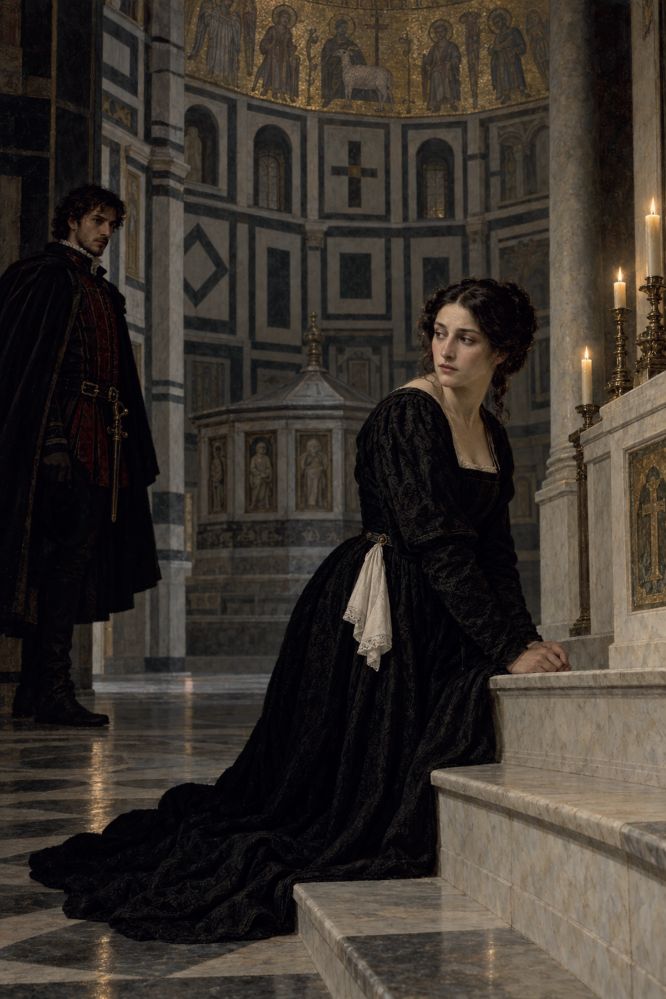
Bianca, AI Generated Image. Created with Text Prompt
Translated from the German by Michael Wooff First published in Stuttgart by G. J. Göschen’sche Verlagsbuchhandlung It was the year of misfortune 1527, the year in which the Eternal City bled under the pikes of the lansquenets, the Pope was a prisoner in the Castel Sant’Angelo and a contagious disease claimed countless victims in every part of Italy. That fine and exuberant epoch, mankind’s second flush of youth, which they called the Renaissance, was going to its grave soaked in blood and horror. For the Florentines there had been a brief glimmer of hope for, in a bloodless coup, they had put the Pope’s nephews, the last two branches of the tree of old Cosimo, outside the city gate and, amid the general turbulence, reaffirmed their independence. But, at the pious banquet of thanksgiving tha twas meant to celebrate this inglorious victory, their drowsing foe, the plague, reared its head once again and, nourished by the coming together of such a great mass of people, took them to its bosom with the force of a conflagration raging through dry wood. The more prosperous part of the populace had fled to the countryside or to neighbouring villas. Whoever was chained to the city by poverty or affairs of state locked themselves up in their house, allowed neither friends nor relations to appear before them and remained in intentional ignorance of their fate so as to grant no admittance to any news of death or sad thought. Others sought forgetfulness in glittering Bacchanalia. The busiest streets and squares were deserted, abandoned palaces turned into dens of thieves and a dangerous mob pushed through the streets at night plundering unguarded houses. The authorities, impotent to stop the robberies, preferred to lend a hand themselves and share the booty. Although churches and monasteries had been converted into hospitals, they could not accommodate all the sick, and a whole town for the treatment of the sick was cobbled together from wood and straw huts outside the city walls that ran from the Porta alla Croce to the Porta al Prato embracing half of Florence. They had come in this way to the beginning of the month of August when the disease reached a high point and up to five hundred victims a day were being claimed by it inside the city walls. People still only dared at night and well covered to leave their houses, holding pomanders smelling of spices or heavily scented sponges that they carried pressed to their face “in order to strengthen the brain” as the common people had termed it since Boccaccio’s time but, in fact, so as not to breathe in the infected air. If a friend met a friend, or a brother met a brother, already, at a distance, they gave way to each other or nodded briefly to each other, hurrying past each other, pulling their clothes tightly to them as they did so. Most of the shops were closed. Only fruit and food shops, butchers and bakers continued to ply their trade, but they had dressed their doorway arch with iron bars and buyers had to help themselves to what was on display from the street. So great was the fear of infection that none dared handle money any more with bare hands but the traders stretched out to the customers a small wooden or iron shovel to put the coins on and then threw them in a bowl filled with water instead of a cash drawer. The municipality had of course appointed its own officials to engage in the fight against the plague, the uffiziali della sanità or, as wits among the people termed them uffiziali del morbo, and state intervention ensured that everything prescribed by the medical knowledge current at that time to curb the disease had been put into practice and, as had already been the case in previous epidemics, had proved just as useless. To keep people living in the countryside away from them, the city gates had been closed. First stricken houses, then streets, and, finally, whole sectors of the town had been cordoned off. The pious hoped through fasting, penitential practices and public prayer to placate God’s anger and had brought the Madonna di Impruneta, the ancient patron saint who protected against plague, inside the walls of Florence. Worldlings meanwhile sought salvation in strong spices, with which they embalmed their body while it was still alive, and in a cosseted and carefree lifestyle. But the plague laughed at all barriers, leapt from districts affected by it to hitherto healthy districts, made its way, leaving behind it heaps of corpses, to the heart of the old town, to the Mercato where stood the ancient palazzi of the great and good, as it did to the villas that surrounded the town like a green wreath. Death struck the priest at the altar, striking him down among the faithful like a flame that catches and devours all around it. The wives of the rich purchased it in valuable brocades that came from plague-infested warehouses and the Santa Madonna di Impruneta gazed impotently down from her frame at pitiful scenes of destitution she was unable to conjure away. Rising prices made things worse and, as they led to an increase in misery and uncleanliness, they gave the plague fresh impetus. Soon the houses were few that did not proclaim to the populace by a white cloth hung before the door that one of their residents had succumbed to the contagion. Then, on the street, in the houses, on top of the roofs, notaries could be seen with their clerks drafting last wills and testaments, priests in their vestments on public squares hearing confessions, so eager to prepare themselves for death were citizens of every age and social status. On a sultry August evening in Florence, as the baked earth was still steaming from a short and therefore not refreshing bout of rain and another thunderstorm loomed overhead in the leaden grey sky, a young man, whose gait and posture set him apart from all other passers-by, strolled slowly out of the Arco de’ Pecori and crossed the Piazza San Giovanni. He was of middling size and fair of face. His carefree attitude and his pampered yet supple build showed him to be a man of the world. He did not wear his blond hair combed forward on his brow in the old way of Florentine youth, but short and fluttering freely round the temples. How calmly he walked, dressed in Spanish clothes that were the height of luxury, as if the devastating, miserable pictures, crouching in wait for him at every street corner, were, quite simply, not reflected in his eyes. He bore neither spices nor strong essences in his hand, but merely a bough of jasmine, from which emanated apenetrating fragrance and which he, from time to time, with an absent-minded smile, pressed to his lips, so that it did not appear that he was trying to protect himself from infection, rather that the odour was conjuring up for him agreeable associations. Those he met with threw him looks of amazement. Rank and riches had not lost their magic so totally that you would have gone past the only son of the wealthy Marco Vettori without calling out to him a polite “Buona sera, Ser Filippo!” As he sought to turn the corner at the Loggia del Bigallo, the cloaked brothers of the Misericordia came towards him with an empty coffin. He got out of their way but, instead of baring his head before these heroes of brotherly love as was customary, he turned away in disgust and his eye came to rest on a quack doctor, ridiculously dressed in bright colours, who was sitting in an overturned cart before the open door of San Giovanni, extolling the virtues of his miraculous pills, sure remedies against the plague, in a voice made hoarse from shouting. As he went on his way with face averted, he collided with someone else, who, clad in a dark travelling cloak, had just turned the corner in a hurry. They crashed into each other head on and backed away startled. “What are you doing here, Alessandro?” said Filippo, after having gazed into the other’s shadowed face, half hidden by the hat he wore for travelling. “What brings you to Florence? But you’ve come at the right time nonetheless.” “Yes,” said Alessandro, warmly shaking hands with his friend. “In times like these a man belongs in his hometown. I’ve therefore come to offer my services to the Signoria. I could sooner ask how is it that an Epicurean like you comes to be in this town of woes? I thought you’d have fled to the Mugello a long time ago to stage a new Decameron in one of your villas.” “What can I tell you?” answered Filippo. “I have practised for twenty-five years the art of living and now I want to learn how to die—with art and with pleasure should it come to that. I have issued a challenge to the plague and would fain see who leaves the field first, it or me.” “Will a beautiful woman keep you company or will there be several?” “Their quantity is irrelevant,” laughed Filippo. “Love is the only currency that does not lose its value in sharing. But tell me, is it true that you’re thinking of marrying one of the Strozzi sisters?” “Madonna Clarice is my wife already,” said Alessandro, “and I think that this marriage will build for me a ladder to the highest office.” “Please don’t talk to me of the actions of governments,” the other cut in quickly, “for they are not worth the ambition of a head so brilliant, let alone a drop of that heart’s blood. What can you expect of these people? Our Gonfalonier hangs his head and gives his support to the monkish faction. Niccolò Machiavelli is dead. Francesco Guicciardini lives in exile. The others are sheep who have donned the skins of lions. We have performed here the most laughable of farces…” “That’s all too true, Filippo!” “The Medici, the handsome Ippolito and his cousin who looks like a Moor, went for a walk outside the town and we heroically closed the gates behind them. That’s all we did. But afterwards came the longwinded speeches on liberty and civic greatness!” Alessandro nodded. “I was sitting at a table with a few friends when the alarm sounded. I tossed a coin in the air and called out: ‘Republic or Medici!’ It came out the lily. We took to the street and shouted: ‘Down with the supporters of the balls!’ But when, after that, there were bloody heads in the Piazza, the fun got too much for me and I went home. This is the way that politics must be conducted in Florence. It doesn’t matter whether it’s the Pope or the Emperor who sticks us in his pocket, he’ll find our town empty. Thanks today to our devout leadership, the gravedigger rules over Florence.” “I don’t recognize my hometown anymore,” said Alessandro. “All is dead and quiet in the streets, no-one gapes and makes a noise, there are no youths here showing off their sartorial elegance and how handsome they are, no traders crying their wares. There’s not even a sound in the Mercato other than the ringing of the plague bells. Near the Porta al Prato I saw, coming towards me, a single vehicle, to which were harnessed two black horses. I believed it to be the litter of a dowager when in fact it was a terrible carnival float, meant to depict the triumph of the plague. Gravediggers, dressed to the nines, were dancing near a cart, jingling gold coins, and shouting: Long live the plague! I walked through where the shacks are and tried to count the huts that have mushroomed on the ground there one after another: I had already got to six hundred when I got tired of counting. But the worst thing I saw was in Borgo San Lorenzo where I wanted to visit my old teacher, the excellent and scholarly Messer Federigo. When I came to his house, facing the front of a church, I saw the old man sitting on his stone threshold in his red jerkin, for he still wore the old garb of Florence, his head leaning back against the door. I called to him from a distance and waved but he didn’t hear me. When I came nearer, I saw his face was black and his toothless jaw was hanging. The old man was dead, Filippo, and sitting on his threshold, asking in vain to be buried since the previous day. His sons had left him after he got sick and his neighbours had dragged him out, when he was dead, so that they could lean him against the door. This the children told me who were standing around gawping.” Filippo shook himself and said morosely: “I have ordered my servants, under pain of dismissal, never to mention to me cases of illness or death. In the street I turn my head as soon as I hear the bell of the corpse cart. It wouldn’t matter if my own father lay in it. What demon drives you to seek out all these horrors?” “My sister’s husband too is dead,” Alessandro continued. “My sister herself has disappeared. Perhaps she’s in hospital, who knows? The Riccis, who were quarrelling with me over the inheritance, have died out completely and have left me not only what’s mine, but also what’s theirs. In this way the plague may well have mediated once and for all in many an old quarrel. My servant Pagolo is dead, the fair Niccolosa is too. I’ve come to a necropolis, Filippo. I walk around here, touch myself and wonder if I’m still alive myself!” “That’s what handsome Cecco, the giant, must have wondered too, who looked as if he’d live to be a hundred,” said Filippo. “He was at the Porta Pinti. We were out for a walk when the plague cart came towards us and in it lay a wondrously beautiful dead girl. Cecco in his exuberance stops the cart and sticks his head inside to kiss the girl’s corpse. A few hours later he got sick and, after two days, he was lying in the self-same cart. But why are we standing here and wailing like old women: this person’s dead and that person’s dying. Let’s leave the dead to bury the dead and hang on to our joy to our last drop of blood! Happy he who need not reproach himself for missing a single beautiful moment. Did you know how sweet the kisses are that death adds spice to, how the strongest lips thirst for a drop from the glass that is being drained? Now life passes quickly and the content of years is pressed into a day. Naked and not false, as God created it, each soul stands before you. Now there’s no more call for long courtship, with sighing and languishing, no more parading under the windows of the fair one, for a word suffices to open all doors: Madonna, this may be our last night to live. What a pity to miss out on the ultimate pleasure! This magical formula drives the nun from the altar into your arms and the widow away from the corpse of her husband. To be in the morning no more! The beautiful arms that today are embracing you shall presently fall victim to hideous decomposition. It’s a drop in the chalice of enjoyment that clouds the senses. It makes you reel. Every drink in future will be vapid and empty. I thought myself a master in the art of living and see that until now I derived no real enjoyment from anything. Come, Alessandro, we should found a society they’ll still be talking of in Florence a hundred years hence. The last of my grandchildren ought to be saying that when joy was driven from the world, it found a refuge in the house of Filippo Vettori. I shall place before my door the statue of the Plague leading blind Cupid by the hand, executed by the greatest artist in Florence. Then we’ll venture abroad, another and cleverer Misericordia, and seek guests for our feast. Whoever is young, beautiful, and witty, whoever still has a spark of zest for life glowing in them, we’ll make welcome. I’ll titillate my table with the finest wines. The most sublime music shall flatter our ears. We shall have conversations the like of which Socrates and Alcibiades shall envy us for. Whoever is overtaken by fate shall be no more asked about. Let no-one have reason to sing a dirge! Should the most beautiful woman in our circle die, tomorrow we’ll embrace one more beautiful! Euthanasia shall be the name of our society and we shall greet one another with the words: Die well! Are you with us, Alessandro, or does Madonna Clarice hold you too tightly under her spell?” The other moved his hand as if he were shaking a straw from his sleeve. “I’ll be there as far as the nights are concerned, but I must keep the day free to do things myself. Early tomorrow I’ll introduce myself to the priors of the brotherhoods. My life, as you know, belongs to the state now...” “Good, I’ll leave you the day to save our fatherland,” Filippo laughed merrily, “but at night you’ll be mine. You’ll always find the odd friend, male or female, at my place. Thus may, what with our festivities and the bawling of the Dominicans, old Florence go forth to its final hour! Are you coming with me right away?” “No, thank you. I still have a lot to do today. First, I must order my affairs, for they’ve set up the administration in a hospital. But tomorrow I’ll be with you, tomorrow night.” “Tomorrow’s too late. Come with me today in preference. My heart tells me that you ought to come today. You know that wise saying of the great Lorenzo: Chi vuol esser lieto, sia! Di doman non c’è certezza! He who wants to be happy, let him be that! What tomorrow will bring none can say! Now there can be no more changes to an appointment agreed in advance.” He tried to convince his friend of this but the latter defended himself and insisted on putting it off till the following day. Filippo had to admit defeat. He made ready to go and called back to his friend: “Make sure you come! Good night!” “I’ll come! Good night!” came the answer. But, in their stars, things were written differently. Alessandro di Francesco della Stufa came from an old, respected Florentine family. He was young, handsome, and wealthy and had received an education no whit inferior to that of any of his contemporaries. The leading humanists of Italy had been his teachers and he had learned statecraft in the school of Francesco Guicciardini. He had spent his last years in foreign embassies and only seen his hometown again on short visits. He knew the courts of Rome and Paris, had been honourably received in Venice by the Serenissima and had everywhere lived in the company of leading statesmen and scholars, and of the foremost artists. He had been spoiled by the fairest and most celebrated women of his time. He had recently in Lucca taken as his wife a fellow Florentine, the proud Clarice degli Strozzi. In Florence he had once commended to another his heart and his hand, but that had been long ago. After Filippo had left him, he entered, deep in thought, the portal of San Giovanni, where, twenty-six years earlier, he had been baptized. On entering he dipped his finger in the holy water stoup for, although an adherent to the teaching of Plato, he had, in all his habits, remained a son of the Church. A blind beggar in rags was kneeling at the entrance and a few candles were burning dimly on the high altar. The rest of the church lay in shadow. The throng of the faithful, who otherwise filled the church in the evening as if it were a house held in common, had vanished. Alessandro walked a few steps through the echoing space. Then he turned back to the altar and spied on the chancel steps a female form sunk in heartfelt prayer that he had at first not noticed as the woman was kneeling near the door he had used to come in. Of her face that she kept turned towards the altar all he could discern was a noble, pale, oval shape. A long, black mourning dress enshrouded the whole of her body and yet an indescribable something told him that this woman on her own praying had to be young and attractive. As soon as the young man set eyes on this apparition, earnestness departed from his features. He assumed a more light-hearted attitude, threw back his cloak to reveal the Spanish doublet underneath and made his steps echo more loudly through the empty vault while his sword clinked softly on the church’s mosaic floor. The praying woman started, turning to him a beautiful, albeit pale as marble face, to which the uncertain light coming from the altar imparted a strange charm. The young man went up to her and said modestly: “Madonna, I see you’re alone. Soon the church will be closed. The streets are swarming with suspicious-looking riffraff. Will you trust me to protect you and accompany you home?” Bianca—for that was her name—shook so violently at his words that she had to support herself with her arm on the stone steps next to which she had knelt. She answered jerkily in an uncertain voice with her head lowered: “Sir, I no longer have a home. The house of God is now my home.” The young man bent down to her sympathetically and said: “Have I frightened you, Madonna? You seem as though weighed down by heavy grief.” She raised her head and spoke to him charmingly: “Yes, I was startled when I heard that voice I never thought to hear again. Do you no longer know this poor Bianca to whom you once intimated that she was close to your heart?” “Bianca,” stammered the young man. “It’s you and all alone at a time like this!” “I’ve prayed to the Lord that He might save this wretched people and me at the same time.” “Oh, He’s surely heard you and you will live,” cried Alessandro, who no longer knew what he was saying and helped her to get up. Her dark eyes glowed feverishly in her pale face. She clung tightly to his arm and her breath brushed his cheek. His eye rested upon her as if bewitched and sought out her familiar traits in the pale yet splendid creature who now stood before him in the full bloom of her femininity and who seemed to him now a thousand times more desirable than in her first adolescent flowering. “My house is deserted, my husband is dead and the servants have all run away,” she whispered. “Dread has driven me out. From every corner ghosts were staring at me.” She sank forward knees first as if she were falling apart and he had to catch her up in his arms to halt her forward motion. “My Bianca,” he said, overwhelmed by compassion and tenderness, “you aren’t alone. I’ve found you again and now I won’t leave you.” In his arms she shuddered. A flash of joy and triumph shot from her eyes like a razor-sharp dagger but he did not see it and she straight away looked down and asked shyly: “Where are you taking me?” He was silent for a moment, and his conscience told him he was in the process of betraying yet again her whom he had once loved so passionately. But the nearness of the beautiful creature, whose heart he felt beat against his, the darkness of temptation and loneliness tore at the whole of his being like a maelstrom in which any finer feeling foundered. Filippo’s discourse roared muddled in his ears. Disaster hovered so nearly over their heads and life was so enticingly beautiful. He thought of the long nights he had sighed before her window while her brothers kept her under lock and key, and they could only exchange on the street a fleeting greeting from a distance. He thought of her beauty he had possessed for so short a time before the Signoria had entrusted him with a mission to France. “To where I live, to my house,” he said in a voice in which each syllable seemed to nestle at her feet like a sycophantic lapdog. “Your house is desolate and deserted. Mine too is empty for no homely fire burns there anymore. I’m completely alone. Come with me, Bianca, for I have never forgotten you. A higher power tore us away from each other. How often I have thought of you through all these long years! Every thought I had of Florence, your image was woven into it. And now, Bianca, now we’re perhaps at death’s door, ought we not to still be happy for the short time that’s left to us?” “Yes,” she said determinedly, and squeezed his arm tightly. “I’ll come with you.” A wicked smile suddenly played on her face, but, bending down to her, he missed it and quickly kissed her. She pulled away from him, took a step backwards and indicated with her half-turned face the altar. As she did so a white cloth came into view that she was wearing fastened to her belt like a sash. He paled, stepped back, and asked shamefacedly: “What does this cloth mean?” She laughed out loud so that it echoed uncannily through the vault. “Does this flannel frighten you?” she said. She was silent for a bit, then resumed. “I tied it on so I could come here unmolested. You said yourself the town is swarming with suspicious-looking riffraff. Wearing this you’re as safe as if an angel had spread over you his wings.” His warm blood had suddenly run cold. A feeling of discomfort troubled him in every limb. Her demeanour seemed to him alien and strangely excited. But he was ashamed to give in to this impulse. He tore from her in something like a fit of anger this white cloth that, like the rattle of lepers in the East, makes its bearer in the eyes of fellow creatures into the stuff of nightmare. “Now I will protect you,” he said. As a result of his sudden gesture he had been left with her belt in his hand at the same time. Her broad, black overgarment fell open to reveal underneath a linen shift as fine as lawn, hugging and embroidered at her breasts with golden thread and, from there, falling to her ankles. He caught hold of her again. She followed the movement of his arms and laid her face against his shoulder so that her long, now loosened hair, fell over one arm while she clung to him with both hands as if she feared that he would once again escape her. “Come, come away from here!” she whispered in his ear. He lifted her and carried her out of the church like a child. This time he forgot to dip his finger in the holy water at the threshold and might easily have stumbled over the blind beggar who had fallen asleep at the entrance. When they stood outside in the open air, it was she who pulled at him so urgently it seemed she could not bear to waste one single blissful minute. The sky had grown as black as coal. The wind swept down the via Calzaiuoli and flung in their faces a dust storm. Madonna Bianca suddenly stopped, put her hand on her heart, and gave a deep and sorrowful sigh. “Close your eyes,” he said. “I’ll lead the way.” He wrapped half his cloak around her and twined an arm around her body, gently supportive of her as she walked so that he seemed to be carrying her under his arm like a bundle. They came to a halt to draw breath on the Ponte Vecchio. The heavy clouds finally were rent like a curtain in the west, making it possible to see a monstrous sulphur-yellow mass of fire. The valley for a moment stood in flames and then grew even darker than before. “Is this not the end of the world that Brother Ambrogio announces to us daily from the pulpit?” whispered the woman, snuggled in the young man’s arm. They continued, now brushing the railings. Alessandro bumped his foot against a soft heap and drew it back in terror. A black splodge lay upon the ground, even blacker than the darkness that surrounded it. Alessandro knew instantly that he had trodden on a human body, for so great is the worth of the human body that it gives rise to a timidity born of instinct, even in the most extreme of profanations and the darkest night. Nor was it the only corpse that one could see these days simply lying in the street. “An astrologer told me not long ago that, on the way that leads to love, I should find death,” said the young man with a forced laugh. “Now I’m going that way and here lies death.” When they arrived in the vicinity of the via de’ Bardi, where Alessandro’s house was, Bianca suddenly asked: “And where is Madonna Clarice?” Alessandro was dismayed. “Don’t speak of her! Don’t think of her! She’s far away and has here no dominion over us.” “Doesn’t she love you then that she dispenses with sharing this present danger with you?” “She doesn’t have to love me. She just has to obey me,” was his brutal reply. From then on Madonna Bianca said not a single word more the whole way. As day was dawning, Alessandro awoke from a restless sleep. There was a hammering in his temples, his lips were parched and, in his chest and under his armpit, he was experiencing a disagreeable sensation of tightness and burning. “I’ll have to send for the doctor,” he said apprehensively, raising his head. “Sir, you’d do better to call for the priest,” Madonna Bianca interjected coldly, without getting up from her seat, from where she had now for hours, pale and motionless, gazed down at the sleeper. He stared at her with wide open eyes. She pulled down her white linen undergarment and he saw, in the wan morning light, on her breasts the colour of marble, three small bright red vesicles surrounded by a swathe of livid flesh. “Look,” she said. “I forgot to show you this last night.” An ice-cold hand struck his heart and before him stood the dreadful spectre of annihilation. The very next moment he became boiling hot, ripped open his shirt, and saw on his chest the same small bright red marks, the worst known form of plague in those days, symptomatic of certain death. He jumped from the bed as if he wanted to strangle the woman. But he stopped with clenched fists in front of her and merely uttered dully: “You, you, you’ve done this to me!” “Yes,” she said calmly, with a smile that resembled that of mad people, “I, the unhappy Bianca, the bloom of whose youth you stole, whom you abandoned to the anger of her relatives and drove into the arms of a man who was not worthy of her, who yesterday you fetched from an altar only to deceive her again. I am a woman whose life you have poisoned and who has now forfeited her eternal salvation through the most heinous and abominable deed the world at large has ever contemplated. But I don’t regret it. When misfortune broke over our town and everyone sank to their knees and pleaded with God to be rescued, my heart alone rejoiced at the slaughter. And I had no inkling of what revenge, what supreme happiness still lay in store for me. Never again will the blonde Clarice enjoy your love. Oh, what are all the powders of the Borgias and the Medici compared to sensuality? You tender to your foe your own mouth like a poisoned chalice and say to him: Drink! Was the cup not tempting? Was the drink not sweet? It worked on you faster than I thought it would.” He broke into a string of wild curses and raged through the room like someone desperate. He heaped upon her the most frightful threats, but whether it was due to the force of the illness he was now crippled by, or to the demonic nature of the woman before him, he did not dare to lift so much as a finger against her. She let him rage and sat there without moving. Suddenly she raised her hand and interrupted him. “Quiet,” she said, smiling uncannily. “Can you hear that ringing down the street? That’s the cart before which every living thing shudders and creeps away. In a few hours they will lay us out together in that cart, into one grave they will throw us both and our souls will be welcomed into one fire of damnation. Would that a storm wind could carry us into everlasting torment, soldered together for all eternity like every other wretched couple!” “Monster! Megaera!” he said with the deepest abhorrence. “A pox on your cowardly deed! But at least you won’t have the last word. I won’t die in your company. I’ll summon my servants...” He wanted to rush out but, squeezing his arm, she held him back. “Stay,” she said in a tone of voice in which hate vied with tenderness. “If you summon your servants, they’ll put you in a makeshift hospital from where only gravediggers will fetch you out again! Stay here. I’ve had my revenge. You’ll receive from my hand now every care that can make your death easier, for a wondrous strength keeps me upright.” He no longer heard. He was staring distractedly in front of him and let himself be taken back to his bed, down onto which he staggered. His fury appeared to have taken from him all will to live and to have left a fever in sole charge of his body. He stretched out once again his head, for he thought he had heard the big bell calling the citizens of Florence, in time of need, to their parliament. “The Signoria’s waiting for me,” he mumbled with a heavy tongue, but a buzzing began in his brain, deep numbness seized him and his eyes glazed over. After a while he opened his lips and murmured disjointed, incomprehensible words and once it seemed to the pale nurse at his side that he whispered her name: “Bianca!” At this she bent down towards him and kissed him on the brow with her bloodless lips. Then she sat down next to him on the edge of the bed and, staring immutably into the face of the dying man, she waited calmly like an angel of death for his and her last hour. When his friend failed to appear that night as he had promised at the banquet, Messer Filippo Vettori made his way, late at night, with servants carrying torches, to his friend’s palazzo in order to fetch the absentee from there. When he at the entrance tried to grab the knocker, he gripped instead a soft fabric. The servants lit the scene with their torches and Messer Filippo moved back from the door as if bitten by a snake, for he held in his hand a white cloth. He stood for a time deeply shaken. “Poor Alessandro,” he cried. “Who’d have thought yesterday you’d have hung the white flag out already today!” But then it occurred to him that fright and grief made the body more susceptible to the infection. He therefore beat a hasty retreat, singing out at the top of his voice to the night: Quant’è bella giovinezza, Che si fugge tuttavia! Chi vuol esser lieto, sia! Di doman non c’è certezza! How fine a thing youth is and yet it slips by! He who wants to be happy, let him be that! What tomorrow will bring none can say. |